Introduction
Quality inspection is one of the most important steps when importing metal water bottles, stainless steel tumblers, vacuum insulated bottles, travel mugs, sports bottles, and promotional drinkware. For brand owners, importers, wholesalers, distributors, Amazon sellers, retail chains, and corporate buyers, product quality is not only about whether the bottle looks good in a sample photo. It directly affects customer reviews, retail acceptance, repeat orders, brand reputation, refund rate, and long-term supplier cooperation.
Many buyers spend a lot of time choosing bottle shapes, comparing prices, selecting colors, designing logos, and discussing packaging. These steps are important, but they are not enough. Even if the product design is confirmed, bulk production can still have problems if there is no clear inspection process before shipment. Common issues include scratches, dents, coating defects, leaking lids, weak vacuum insulation, wrong logo position, color mismatch, dirty inner walls, missing accessories, damaged packaging, wrong barcode labels, and inaccurate carton quantities.
For B2B drinkware projects, quality inspection should not be treated as a final formality. It should be part of the full sourcing process from sample approval to mass production and shipment. A professional vacuum insulated bottle manufacturer should understand what needs to be checked, when to check it, and how to report inspection results to buyers clearly.
A small defect in a consumer product can become a major business problem when the order quantity is large. For Amazon sellers, a leaking lid or scratched powder coating can lead to negative reviews. For retail chains, barcode or packaging errors can cause receiving problems. For corporate gift buyers, poor logo printing can make the whole order unusable. For importers and wholesalers, inconsistent quality can damage relationships with downstream customers.
This buyer’s guide provides a practical quality inspection checklist for metal water bottles and insulated drinkware. It covers appearance inspection, material checking, vacuum insulation testing, leak-proof testing, lid inspection, coating and surface finish inspection, logo inspection, capacity checking, packaging inspection, carton inspection, AQL sampling logic, common defects, buyer decision tables, and pre-shipment inspection recommendations.
The goal is to help buyers reduce sourcing risk, communicate more clearly with suppliers, and make sure bulk orders match approved samples before products leave the factory.
Quick Buyer Summary
A complete quality inspection for metal water bottles should check product appearance, stainless steel material, vacuum insulation, leak-proof performance, lid function, coating quality, logo accuracy, packaging strength, accessory completeness, barcode labels, carton information, and final shipment quantity. Buyers should approve a pre-production sample first and then use it as the quality reference for mass production inspection.
For most OEM drinkware projects, inspection should happen before shipment. Once goods leave the factory, fixing defects becomes much more expensive. For Amazon sellers, retail brands, and corporate gift buyers, pre-shipment inspection is especially important because product defects can directly affect customer reviews, retail acceptance, and brand image.
| Inspection Area | What to Check | Why It Matters |
|---|---|---|
| Appearance | Scratches, dents, stains, deformation | Protects customer first impression |
| Material | Stainless steel type, plastic lid, silicone parts | Supports safety and compliance |
| Insulation | Hot/cold retention, vacuum failure | Confirms core product function |
| Leak-Proof | Lid sealing, silicone ring, cap closure | Prevents customer complaints |
| Lid Function | Opening, closing, hinge, straw, handle | Ensures daily usability |
| Coating | Powder coating, spray finish, adhesion | Reduces scratches and peeling risk |
| Logo | Size, position, clarity, color | Protects brand presentation |
| Capacity | Actual volume vs product claim | Avoids inaccurate listing or packaging |
| Packaging | Box strength, barcode, insert card | Supports retail and Amazon selling |
| Carton | Quantity, carton labels, gross weight | Prevents shipping and warehouse issues |
Why Quality Inspection Matters for Metal Water Bottle Orders
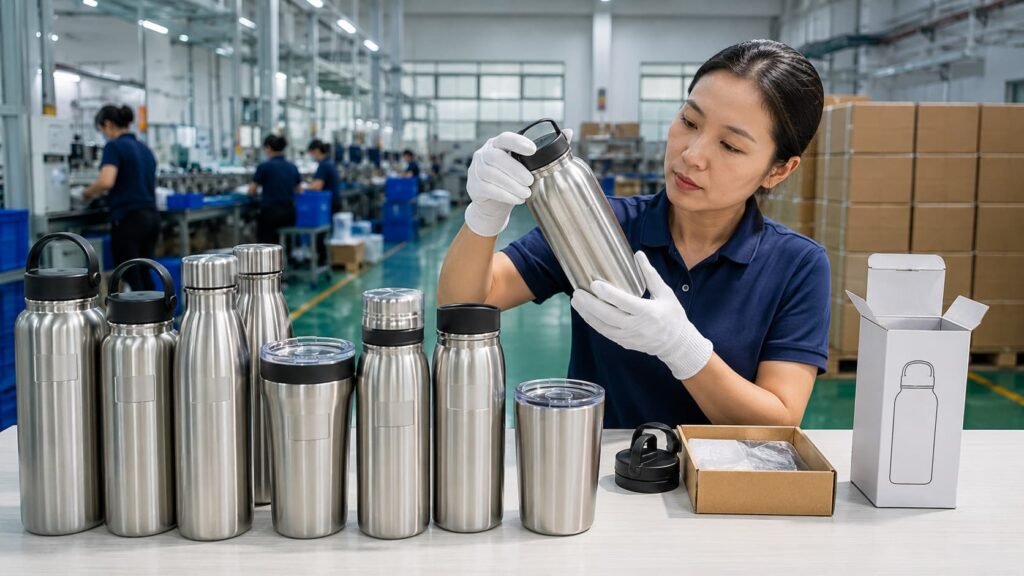
Quality inspection matters because metal water bottles are both functional products and brand-facing products. A buyer is not only purchasing a stainless steel container. They are purchasing a product that will be touched, carried, used daily, photographed, reviewed, gifted, displayed, shipped, and associated with a brand. If quality is unstable, the buyer’s business risk increases.
Unlike simple products, insulated drinkware has many quality points. A stainless steel tumbler may have a clean outer appearance but weak lid sealing. A vacuum flask may look premium but fail insulation testing. A sports bottle may have a strong body but a weak handle. A travel mug may have a beautiful logo but poor coating adhesion. A kids bottle may look cute but have a lid that is difficult to clean. These problems may not be obvious from photos alone.
For importers and wholesalers, quality inspection protects long-term supply stability. If products arrive with defects, the buyer may need to sort, rework, discount, or replace them. This creates extra labor cost, warehouse pressure, and customer complaints. For Amazon sellers, poor quality can quickly damage listing performance. Negative reviews about leaks, scratches, odors, or missing accessories can reduce conversion rate and increase advertising cost. For corporate gift buyers, one visible logo defect can affect the whole campaign because the product is used to represent a company or event.
Quality inspection also helps buyers compare suppliers more accurately. A cheap supplier may seem attractive, but if the defect rate is high, the real cost becomes higher. A reliable vacuum insulated bottle manufacturer should have a clear inspection process and be willing to provide inspection photos, videos, or reports before shipment.
For B2B projects, inspection should be connected to the approved sample. The sample is the quality standard. Before mass production, buyers should confirm the bottle model, capacity, lid, color, logo method, packaging, accessories, and carton packing. During final inspection, bulk goods should be compared against this approved sample.
Quality Inspection Protects More Than Product Quality
| Buyer Type | Main Quality Risk | Why Inspection Matters |
|---|---|---|
| Amazon Seller | Negative reviews, returns, listing damage | Defects appear directly in customer feedback |
| Retail Chain | Rejection, barcode issues, shelf inconsistency | Retail requires stable packaging and SKU control |
| Importer | Customer complaints and rework cost | Bulk defects increase downstream pressure |
| Distributor | Repeat order instability | Quality must stay consistent across batches |
| Corporate Buyer | Poor logo or gift box appearance | Product represents company image |
| Promotional Company | Event deadline and logo accuracy | Defects cannot be fixed after campaign date |
| Kids Brand | Safety, lid usability, leakage | Parents are sensitive to quality problems |
| Outdoor Brand | Durability and leak-proof function | Product must perform in active use |
A good inspection process reduces uncertainty before products enter the buyer’s warehouse or sales channel.
Inspection Stage 1: Pre-Production Sample Approval
Why the Sample Is the Inspection Standard
Before mass production begins, buyers should approve a pre-production sample. This sample becomes the reference standard for bulk production. Without an approved sample, inspection becomes subjective. The buyer may expect one result, while the supplier produces another.
A complete pre-production sample should include the final bottle body, final lid, final color, final logo, final packaging, accessories, insert card, barcode label, and carton packing method if possible. For simple wholesale orders, a standard stock sample may be enough to confirm product structure. But for OEM stainless steel drinkware projects, especially private label, Amazon, retail, and corporate gift orders, a full customized sample is much safer.
Many quality disputes happen because buyers approve based only on catalog photos or digital mockups. A mockup can show logo position and color direction, but it cannot show real coating texture, bottle weight, lid tightness, drinking comfort, packaging protection, or logo durability. Physical samples are necessary when quality matters.
The sample should be checked carefully before mass production. Buyers should test leakage, lid operation, coating feel, logo clarity, color accuracy, bottle capacity, packaging fit, and accessory placement. If any detail is not acceptable, it should be corrected before bulk production.
Pre-Production Sample Checklist
| Sample Item | What Buyers Should Confirm |
|---|---|
| Bottle Model | Shape, size, capacity, body structure |
| Material | Inner wall, outer wall, lid, silicone parts |
| Lid | Opening, closing, sealing, drinking comfort |
| Color | Stock color or custom Pantone color |
| Surface Finish | Powder coating, spray painting, stainless finish |
| Logo | Method, size, position, color, clarity |
| Packaging | Box type, insert, barcode, protection |
| Accessories | Straw, brush, silicone boot, extra lid, card |
| User Experience | Holding, drinking, carrying, cleaning |
| Final Approval | Written confirmation before production |
For custom Pantone colors, buyers should approve a real color sample, not only a screen image. For logo printing, buyers should approve physical logo effect if the order is important. For Amazon FBA, packaging and barcode placement should be checked before production.
Inspection Stage 2: Appearance Inspection
Surface Defects and Visual Quality
Appearance inspection is one of the most visible parts of metal water bottle quality control. Customers often judge product quality within seconds of opening the package. Scratches, dents, stains, dust marks, fingerprints, uneven coating, bubbles, peeling, polishing marks, and deformation can make the product feel low quality even if the basic function is acceptable.
For stainless steel tumblers and insulated bottles, appearance inspection should check the bottle body from multiple angles under good lighting. Matte colors, white, black, pastel tones, and metallic finishes may show defects differently. Buyers should pay extra attention to high-visibility areas such as the front logo area, upper body, bottom edge, lid connection, and handle area.
Dents are especially important because metal bottles can be damaged during production, polishing, coating, packing, or transport. Even small dents may be unacceptable for premium retail products. For promotional drinkware, minor defects may be tolerated within agreed standards, but logo area and visible front surface should still be controlled.
Polishing and welding areas should also be checked. The bottle should not have sharp edges, rough rims, uneven bottom, or visible manufacturing defects. The mouth area should be smooth because it may contact the user’s lips or be cleaned by hand.
Appearance Defect Classification
| Defect Type | Example | Risk Level |
|---|---|---|
| Critical Defect | Sharp edge, unsafe metal burr, severe deformation | Must be rejected |
| Major Defect | Large dent, obvious scratch, peeling coating, wrong color | Usually unacceptable |
| Minor Defect | Tiny mark in non-visible area | May be acceptable within standard |
| Cosmetic Defect | Slight dust mark or tiny surface point | Depends on product positioning |
| Packaging-Related Defect | Scratch caused by loose accessory | Requires packing improvement |
Appearance standards should be agreed before inspection. A premium private label drinkware project should have stricter cosmetic standards than a low-cost promotional giveaway. However, basic safety and function should never be compromised.
Inspection Stage 3: Material and Food-Contact Safety Check
Stainless Steel Material
Material inspection is important because metal water bottles are food-contact products. Most vacuum insulated bottles and stainless steel tumblers use 304 stainless steel for the inner wall. Some premium or special market projects may use 316 stainless steel, but 304 stainless steel is widely used for OEM insulated drinkware.
Buyers should confirm material specifications before production. The supplier should clearly state the stainless steel type used for the inner wall and outer wall. For food-contact drinkware, the inner wall material is especially important because it touches water, coffee, tea, juice, or other beverages.
Material issues can create odor, rust risk, corrosion, customer complaints, and compliance problems. A bottle that looks good outside but uses poor inner material can damage brand trust. Importers and retail buyers may also need material documents for customs, retail chain approval, or marketplace compliance.
Plastic Lid and Silicone Parts
The lid is usually made of plastic parts, silicone seals, and sometimes metal components. Buyers should confirm that plastic parts are BPA-free and suitable for beverage contact. Silicone seals should be food-grade and stable under normal use conditions.
For hot drink products such as coffee travel mugs, lid material should be checked for heat resistance and odor. For kids bottles, material safety is even more important because parents are sensitive to product safety.
Compliance Documents
Depending on the target market, buyers may request FDA-related food-contact documentation, LFGB testing, SGS reports, BPA-free confirmation, or other compliance documents. Testing requirements depend on country, sales channel, product material, and buyer’s compliance strategy.
A professional manufacturer should be able to discuss available documents and testing options. Buyers should confirm document needs before mass production because new testing can affect lead time and cost.
Inspection Stage 4: Vacuum Insulation Performance Testing
Why Insulation Testing Is Important
Vacuum insulation is one of the main selling points of insulated bottles, vacuum flasks, stainless steel tumblers, and travel mugs. If a bottle fails insulation performance, the product loses one of its core advantages. For private label drinkware and retail products, poor insulation can lead to customer disappointment and negative reviews.
Insulation performance depends on vacuum quality, bottle structure, lid design, mouth size, material, and production consistency. A narrow-mouth vacuum flask may perform differently from a wide-mouth sports bottle. A screw lid may retain heat better than a straw lid. A tumbler with a drinking opening may not perform the same as a sealed vacuum bottle.
Buyers should make sure product claims match actual performance. If the listing, catalog, or packaging claims long hot or cold retention, the buyer should confirm the test result. Unrealistic insulation claims can create customer complaints even if the product performs normally for its structure.
Common Insulation Testing Method
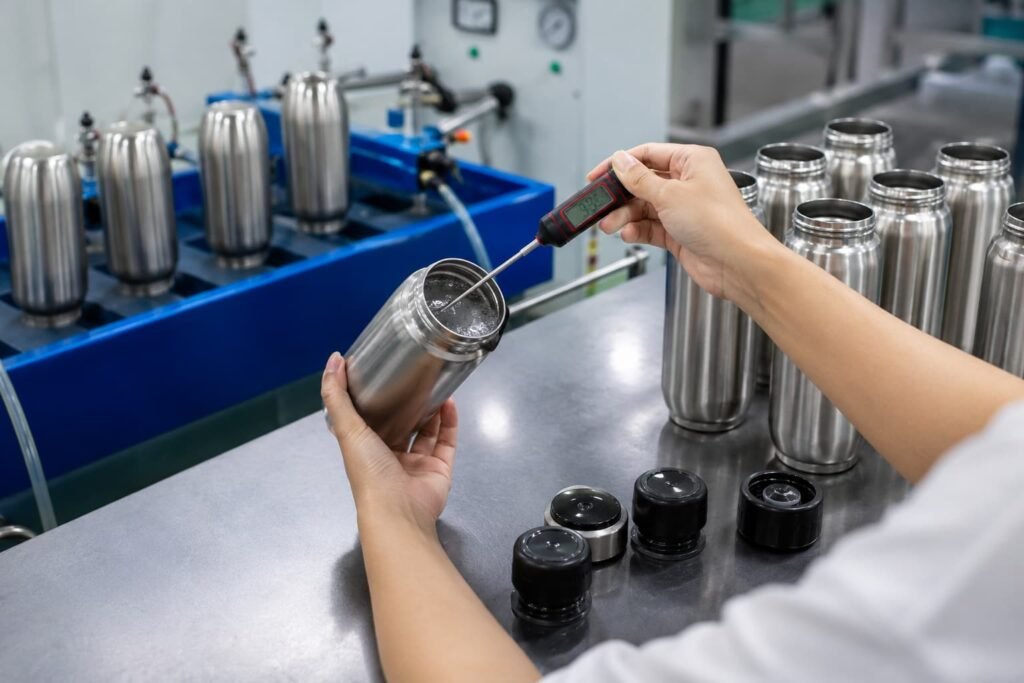
A common insulation test involves filling the bottle with hot water, measuring the starting temperature, closing the lid, waiting for a specific period, and measuring the final temperature. For cold retention, cold water or ice water may be used depending on the test requirement.
The exact test standard should be agreed between buyer and supplier. For factory QC, suppliers may use internal testing methods to detect vacuum failure and compare performance across batches. For premium or retail projects, buyers may request more detailed test data.
| Test Item | What to Check | Why It Matters |
|---|---|---|
| Hot Retention | Temperature drop after set time | Confirms insulation performance |
| Cold Retention | Cold temperature maintenance | Supports cold drink claims |
| Condensation | Outer wall sweating | May indicate vacuum failure |
| Outer Wall Heat | Bottle becomes too hot outside | May indicate insulation issue |
| Batch Consistency | Random sample performance | Ensures stable production |
Insulation testing should be part of final quality control for vacuum insulated bottle projects.
Inspection Stage 5: Leak-Proof and Lid Function Testing
Leak-Proof Testing
Leak-proof testing is one of the most important inspection steps for metal water bottles. A bottle with poor sealing can cause customer complaints, returns, negative reviews, and damage to personal items. This is especially important for sports bottles, kids bottles, school bottles, outdoor bottles, and travel mugs that may be carried in bags.
Leak testing should be done according to the lid type. A screw lid bottle can usually be tested by filling water, closing the lid tightly, shaking it, turning it upside down, and placing it sideways. A flip lid, spout lid, straw lid, coffee lid, or handle lid may require different testing because each structure has different sealing points.
Buyers should understand that not every lid is fully leak-proof. Some straw lids and coffee lids may be splash-resistant but not designed for upside-down carrying. The product claim should match the real function. If the lid is not fully leak-proof, marketing materials should not say it is.
Lid Function Inspection
Lid quality is not only about sealing. The lid should be easy to open, easy to close, comfortable to drink from, and safe during normal use. The silicone ring should fit correctly. The thread should match the bottle mouth. Buttons, hinges, locks, handles, straws, and spouts should function smoothly.
For large-capacity bottles, handle strength should be checked because the bottle becomes heavy when filled. For kids bottles, the lid should be easy for children to use but secure enough to prevent accidental opening. For coffee travel mugs, the lid should control splashing and handle hot beverages properly.
| Lid Type | Inspection Focus | Common Risk |
|---|---|---|
| Screw Lid | Thread fit, silicone seal, tightness | Poor sealing or difficult opening |
| Straw Lid | Straw hole, silicone seal, splash control | Not fully leak-proof |
| Flip Lid | Button, hinge, lock, seal | Breakage or accidental opening |
| Spout Lid | Cap closure, drinking flow, seal | Leakage at spout |
| Coffee Lid | Sipping hole, heat resistance, splash control | Hot drink splash |
| Handle Lid | Handle strength, lid tightening | Weak handle or loose lid |
Lid inspection should be repeated on random samples from bulk production, not only tested on the original sample.
Inspection Stage 6: Coating and Surface Finish Inspection
Powder Coating and Spray Finish
Surface finish affects both appearance and durability. Powder coating is widely used for stainless steel tumblers and insulated bottles because it gives a matte look and comfortable grip. Spray painting, rubber paint, metallic finish, stainless steel polish, and other finishes may also be used depending on product positioning.
Inspection should check color consistency, coating smoothness, dust marks, bubbles, peeling, scratches, uneven texture, and adhesion. For custom Pantone colors, the finished product should be compared with the approved color sample. Buyers should remember that lighting conditions can affect color appearance, so inspection should be done under consistent lighting.
Coating defects are especially visible on dark colors, white bottles, pastel colors, and premium matte surfaces. For retail and private label drinkware, coating quality directly affects perceived value. For outdoor bottles, coating durability matters because users may carry the product in rougher conditions.
Adhesion and Durability Checks
For some projects, buyers may request coating adhesion checks such as tape testing or scratch resistance checks. The exact method depends on the product and buyer requirement. The purpose is to confirm that the coating will not peel easily during normal use.
Logo durability is also connected to surface finish. Some logo methods perform better on certain coatings. Laser engraving, silk screen printing, UV printing, and heat transfer printing all require different inspection points.
Surface Finish Inspection Table
| Surface Finish | What to Check | Buyer Risk |
|---|---|---|
| Powder Coating | Smoothness, adhesion, scratches | Peeling or visible marks |
| Spray Painting | Color evenness, dust marks | Inconsistent appearance |
| Rubber Paint | Soft touch, peeling, dirt marks | Surface wear |
| Stainless Steel Polish | Shine, scratches, fingerprints | Premium appearance issues |
| Metallic Finish | Color consistency, coating stability | Visible batch difference |
| Gradient Finish | Color transition, print defects | High cosmetic defect risk |
The surface finish should match the target market and price positioning. Higher-end products need stricter appearance standards.
Inspection Stage 7: Logo and Branding Inspection
Logo Position and Clarity
Logo quality is critical for OEM and private label drinkware. The logo is often the most visible brand element on the bottle. If the logo is crooked, too small, too large, unclear, scratched, or placed in the wrong position, the product may become unacceptable for the buyer.
Logo inspection should compare bulk production with the approved logo sample. Inspectors should check logo size, position, color, clarity, alignment, and durability. For corporate gift projects, logo accuracy is especially important because the bottle is used to represent a company, event, or promotional campaign.
Different logo methods have different inspection requirements. Laser engraving should be clean and consistent. Silk screen printing should have sharp edges and correct color. UV printing should have good adhesion and color accuracy. Heat transfer printing should be smooth without wrinkles or edge defects.
Logo Inspection Checklist
- Correct logo file used
- Correct logo size
- Correct logo position
- Correct logo color
- Clear edges
- No missing parts
- No smudging
- No scratches
- No misalignment
- No peeling
- Consistent placement across products
| Logo Method | Inspection Focus |
|---|---|
| Laser Engraving | Engraving depth, clarity, position |
| Silk Screen Printing | Ink coverage, edge sharpness, color |
| UV Printing | Color accuracy, adhesion, surface smoothness |
| Heat Transfer Printing | Wrinkles, bubbles, edge quality |
| Full-Wrap Printing | Seam alignment, image continuity, defects |
For important brand projects, physical logo samples should be approved before mass production.
Inspection Stage 8: Capacity, Weight, and Dimension Check
Capacity and dimensions should be checked because product claims must match the actual product. If a bottle is sold as 500ml, 750ml, 1L, 20oz, 30oz, or 40oz, the capacity should be accurate within acceptable tolerance. Incorrect capacity can create listing problems, customer complaints, and packaging errors.
Weight should also be checked, especially for large-capacity bottles, kids bottles, and travel mugs. A bottle that is too heavy may not be suitable for children or daily carry. A bottle that is too light may feel less durable, depending on the market.
Dimensions matter for packaging, retail display, Amazon FBA, and shipping. If the product is taller or wider than expected, the packaging may not fit. If the carton dimensions are different from the shipping plan, freight cost or warehouse receiving may be affected.
Dimension and Capacity Checklist
| Item | What to Check |
|---|---|
| Capacity | Actual water volume |
| Height | Bottle height with lid |
| Diameter | Body width and base width |
| Mouth Size | Opening diameter |
| Weight | Product weight without water |
| Lid Height | Important for packaging |
| Handle Size | Comfort and carton fit |
| Carton Fit | Unit box and master carton suitability |
For Amazon sellers, accurate dimensions and weight are especially important because they affect product listing, packaging, shipping, and fulfillment costs.
Inspection Stage 9: Packaging and Accessory Inspection
Unit Packaging Inspection
Packaging protects the product and shapes the customer experience. A good bottle with weak packaging can still create complaints. For Amazon sellers, retail buyers, and corporate gift projects, packaging quality should be inspected carefully.
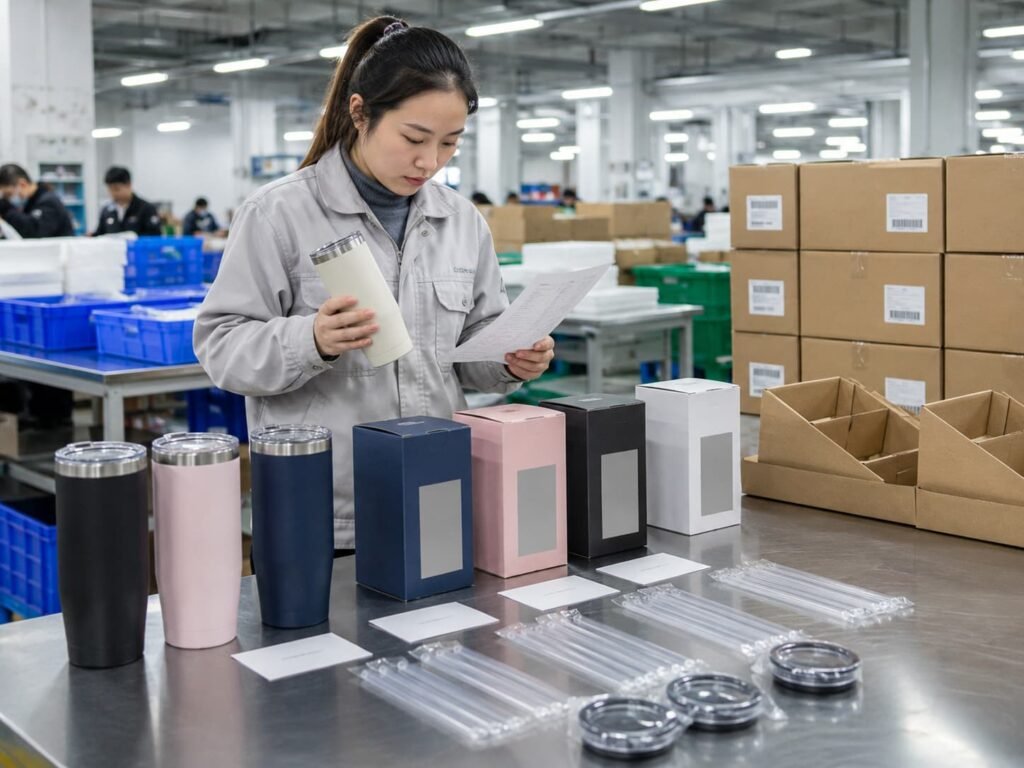
Unit packaging inspection should check box type, box strength, artwork, barcode, product information, insert card, protective structure, and product fit. The bottle should not move too much inside the box. Accessories should be packed securely. The box should not be crushed, dirty, or poorly sealed.
For custom packaging, buyers should check that artwork matches the approved design. Barcode should be scannable. Product capacity and color information should be correct. If the packaging includes QR codes, website links, or care instructions, these should be checked before mass production.
Accessory Inspection
Many metal water bottle projects include accessories such as straws, cleaning brushes, silicone boots, extra lids, replacement seals, gift cards, user manuals, or carry bags. Missing accessories are a common source of customer complaints.
Accessories should be counted and checked during inspection. They should also be packed in a way that prevents scratching or damage. A loose stainless steel straw inside the box can scratch a powder-coated bottle. A small silicone seal can be lost easily if not packed in a small bag.
Packaging and Accessory Checklist
| Item | Inspection Focus |
|---|---|
| Unit Box | Correct type, clean surface, no damage |
| Barcode | Correct SKU and scannable |
| Insert Card | Correct content and quantity |
| Straw | Correct size and quantity |
| Brush | Included if required |
| Silicone Boot | Correct color and fit |
| Extra Lid | Correct type and color |
| Manual | Correct language and product information |
| Gift Box | Appearance and protection |
| Carton Packing | Correct quantity and carton strength |
Inspection Stage 10: Carton and Shipment Inspection
Master Carton Inspection
Master cartons must be strong enough for export shipping and warehouse handling. Stainless steel tumblers and insulated bottles can be heavy, especially when packed in bulk. Weak cartons may deform, tear, or damage unit boxes during transportation.
Carton inspection should check carton material, sealing tape, carton marks, carton labels, total quantity, SKU separation, gross weight, net weight, and dimensions. If the shipment is going to Amazon FBA, carton labels should match the seller’s shipment plan.
For multi-SKU orders, carton marking is very important. Different colors, capacities, and bottle models should be separated clearly. Mixed SKUs without clear labeling can cause warehouse confusion and Amazon receiving problems.
Shipment Quantity Check
The final shipment quantity should match the purchase order, packing list, and carton count. Buyers should check units per carton and total cartons before shipment. If there are shortages or overages, they should be clarified before loading.
For larger orders, inspection may include random carton opening to verify product inside. The inspector should confirm that carton contents match carton labels.
Carton Inspection Checklist
- Carton strength
- Carton sealing
- Carton mark
- Carton label
- SKU information
- Color information
- Quantity per carton
- Gross weight
- Net weight
- Carton dimensions
- Total carton count
- Pallet condition if applicable
- FBA labels if required
- Shipping marks
Carton inspection may seem basic, but it prevents many logistics and warehouse problems.
AQL Inspection: What Buyers Should Understand
AQL stands for Acceptable Quality Limit. It is commonly used in third-party quality inspection to decide how many units should be inspected and how many defects are acceptable within a batch. Buyers do not need to become inspection experts, but they should understand the basic idea.
In bulk drinkware inspection, defects are usually classified as critical, major, and minor. Critical defects affect safety or make the product unusable. Major defects affect function, appearance, or customer acceptance. Minor defects are small issues that may not seriously affect use or appearance.
For example, a sharp metal burr near the mouth is critical. A leaking lid is major. A large visible scratch is major. A tiny mark at the bottom may be minor depending on agreed standards.
Defect Classification Table
| Defect Level | Meaning | Example |
|---|---|---|
| Critical | Unsafe or unusable defect | Sharp edge, broken dangerous part |
| Major | Product may be rejected by customer | Leakage, large dent, wrong logo |
| Minor | Small defect with limited impact | Tiny mark in hidden area |
AQL inspection helps buyers make objective decisions instead of relying only on general impressions. For important orders, buyers may ask the supplier or third-party inspection company to inspect according to an agreed AQL level.
Buyer Guide: How to Build a Quality Inspection Plan
Step 1: Define the Quality Standard Before Production
Buyers should not wait until final inspection to define quality expectations. The standard should be clear before production. This includes approved sample, color sample, logo sample, packaging sample, and defect tolerance.
Step 2: Confirm Critical Inspection Points
Different products have different inspection priorities. A kids bottle should focus on safety and lid usability. An outdoor bottle should focus on leak-proof performance, handle strength, and coating durability. An Amazon tumbler should focus on packaging, accessories, barcode, and review risk.
Step 3: Approve a Complete Pre-Production Sample
A complete sample helps align buyer and supplier expectations. It should include final product, logo, color, lid, packaging, accessories, and barcode if applicable.
Step 4: Inspect During Production If Needed
For large or complex orders, buyers may request during-production inspection. This helps catch problems early before the entire batch is completed.
Step 5: Conduct Final Inspection Before Shipment
Final inspection should happen when goods are packed but before shipment. This allows defects to be corrected before products leave the factory.
Step 6: Review Inspection Report and Decide Shipment Release
Buyers should review photos, videos, test results, defect list, and carton information. Shipment should only be released after the quality result is acceptable.
Quality Inspection Checklist by Buyer Type
| Buyer Type | Priority Inspection Points |
|---|---|
| Amazon Seller | Leak-proof test, packaging, barcode, accessories, logo, surface defects |
| Retail Chain | Packaging artwork, barcode, color consistency, compliance documents |
| Importer | Bulk consistency, carton quantity, product durability |
| Distributor | Repeatable quality, SKU separation, carton marking |
| Corporate Buyer | Logo accuracy, gift box appearance, delivery quantity |
| Promotional Company | Logo position, event deadline, carton quantity |
| Kids Brand | Safety, lid function, small parts, BPA-free parts |
| Outdoor Brand | Coating durability, handle strength, leak-proof performance |
| Fitness Brand | Straw lid, capacity, grip, logo durability |
| Office Gift Buyer | Premium appearance, packaging, logo quality |
This table helps buyers focus on the risks that matter most to their sales channel.
Common Mistakes Buyers Should Avoid
One common mistake is approving production based only on photos. Photos are useful, but they cannot fully show lid tightness, coating texture, logo durability, insulation performance, or packaging protection. Physical sample approval is much safer.
Another mistake is inspecting only the bottle body and ignoring the lid. In many drinkware orders, the lid creates more complaints than the bottle itself. Buyers should test lid sealing, opening, closing, silicone parts, straw hole, and handle strength.
Some buyers also ignore packaging inspection. Packaging errors can create Amazon FBA problems, retail rejection, and poor customer experience. Barcode, box strength, insert card, and accessory packing should all be checked.
Another mistake is not defining defect standards in advance. If the buyer and supplier do not agree on what counts as major or minor defect, disputes may happen during final inspection.
Buyers should also avoid skipping inspection to save time. If defects are found after arrival, the cost of sorting, repacking, returning, or discounting products can be much higher than inspection cost.
Common Inspection Mistakes and Better Solutions
| Mistake | Why It Creates Risk | Better Solution |
|---|---|---|
| Only checking product photos | Real function cannot be verified | Approve physical samples |
| Ignoring lid testing | Leakage complaints | Test lid function before shipment |
| No approved color sample | Color mismatch | Confirm physical Pantone sample |
| Skipping packaging check | Retail or Amazon issues | Inspect box, barcode, and accessories |
| No defect classification | Disputes during inspection | Define critical, major, minor defects |
| Inspecting too late | No time for correction | Inspect before shipment release |
| Ignoring carton details | Logistics problems | Check carton labels and quantity |
| Not checking accessories | Missing-item complaints | Use accessory checklist |
| Making unsupported claims | Customer complaints | Match claims with test results |
| Choosing supplier only by price | Higher defect risk | Compare quality control ability |
Good inspection is not about finding problems after they happen. It is about preventing business risk before shipment.
FAQ
What should be inspected before shipping metal water bottles?
Buyers should inspect appearance, stainless steel material, lid function, leak-proof performance, vacuum insulation, coating quality, logo accuracy, capacity, packaging, accessories, barcode labels, carton information, and shipment quantity.
Is leak-proof testing necessary for every insulated bottle order?
Yes, especially for sports bottles, kids bottles, outdoor bottles, travel mugs, and products sold through Amazon or retail. Lid leakage is one of the most common causes of customer complaints.
How do buyers check vacuum insulation performance?
A common method is to fill the bottle with hot or cold water, record starting temperature, close the lid, wait for a set period, and measure final temperature. The test method should match the product type and marketing claim.
What is the difference between critical, major, and minor defects?
Critical defects affect safety or make the product unusable. Major defects affect function, appearance, or customer acceptance. Minor defects are small issues with limited impact. Buyers should define these standards before inspection.
Should buyers use third-party inspection for bulk drinkware orders?
For large orders, retail projects, Amazon products, or first cooperation with a supplier, third-party inspection can reduce risk. For smaller repeat orders with a reliable supplier, factory inspection reports may be enough depending on buyer confidence.
What is the MOQ for custom metal water bottles?
Stock colors require 100 pcs per color. Custom Pantone colors require 500 pcs per color. Custom lid colors require 1,000–3,000 pcs per color. ODM new mold products require 3,000–5,000 pcs per color.
Should inspection compare bulk goods with the approved sample?
Yes. The approved pre-production sample should be the quality reference for mass production. Bulk goods should match the approved sample in model, color, logo, lid, packaging, and accessories.
How can Amazon sellers avoid quality problems before FBA shipment?
Amazon sellers should check product quality, lid performance, barcode, FNSKU labels, packaging, insert cards, accessories, carton labels, and SKU separation before shipment. Pre-shipment inspection is strongly recommended.
What packaging problems should buyers check?
Buyers should check box strength, box artwork, barcode accuracy, insert card, accessory packing, product fit, carton quantity, carton labels, and carton strength. Packaging affects both customer experience and logistics.
Can a factory inspect products before shipment?
Yes, a professional vacuum insulated bottle manufacturer should have internal QC inspection. Buyers can request inspection photos, videos, test results, and packing details. For larger orders, third-party inspection can also be arranged.
Conclusion
Quality inspection is essential for importing metal water bottles, stainless steel tumblers, vacuum insulated bottles, travel mugs, sports bottles, coffee mugs, private label drinkware, and promotional drinkware. A good inspection process helps buyers reduce defects, protect brand reputation, avoid customer complaints, and improve long-term supplier cooperation.
For B2B buyers, inspection should begin before production, not after shipment. The first step is approving a complete pre-production sample. This sample becomes the quality standard for mass production. Buyers should confirm the bottle model, material, lid, color, logo, packaging, accessories, barcode, and carton packing before production starts.
During final inspection, buyers should check appearance, material, insulation performance, leak-proof function, lid operation, coating quality, logo accuracy, capacity, packaging, accessories, carton labels, and shipment quantity. For large or high-risk orders, AQL inspection or third-party inspection can provide additional control.
Different buyers should focus on different risks. Amazon sellers should pay close attention to leak-proof testing, packaging, barcode labels, and accessories. Retail buyers should check packaging artwork, barcode, compliance, and color consistency. Corporate buyers should focus on logo and gift box quality. Outdoor brands should test coating durability, lid sealing, and handle strength. Kids bottle buyers should prioritize material safety, lid usability, and leakage control.
A reliable vacuum insulated bottle manufacturer should support buyers with sample approval, quality inspection, testing guidance, packaging solutions, and clear communication before shipment. The best inspection process is not only about finding defective products. It is about preventing business problems before they reach customers.
For brand owners, importers, wholesalers, distributors, promotional product companies, Amazon sellers, retail chains, and corporate buyers, quality inspection is one of the most practical ways to protect profit, reputation, and customer trust in bulk drinkware sourcing.
👉 Contact us for OEM stainless steel drinkware customization, logo printing, Pantone color matching, packaging solutions, and fast quotations for your next project.