
An insulated bottle with handle can look like a small design variation, but for B2B buyers it affects much more than appearance.
The handle changes how the bottle is carried, how heavy it feels when filled, whether it fits into retail packaging, how much stress is transferred to the lid, how suitable it is for outdoor or fitness use, and even whether the product feels premium, sporty, lightweight, or bulky.
For buyers sourcing stainless steel water bottles, the three most common handle directions are:
- Hard handle
- Soft loop
- Integrated lid handle
There is no single best option for every project.
A large-capacity outdoor bottle may benefit from a rigid hard handle because the filled weight is high. A gym or lifestyle bottle may work better with a flexible soft loop because it adds less bulk. A slim travel bottle or corporate gift bottle may be better with an integrated lid handle because the silhouette stays cleaner.
The right choice depends on bottle capacity, target user, carrying behavior, sales channel, packaging, lid structure, and MOQ.
For a brand launching a new insulated bottle, the handle should therefore be selected as part of the overall product strategy, not as a last-minute accessory.
Buyer Decision Snapshot
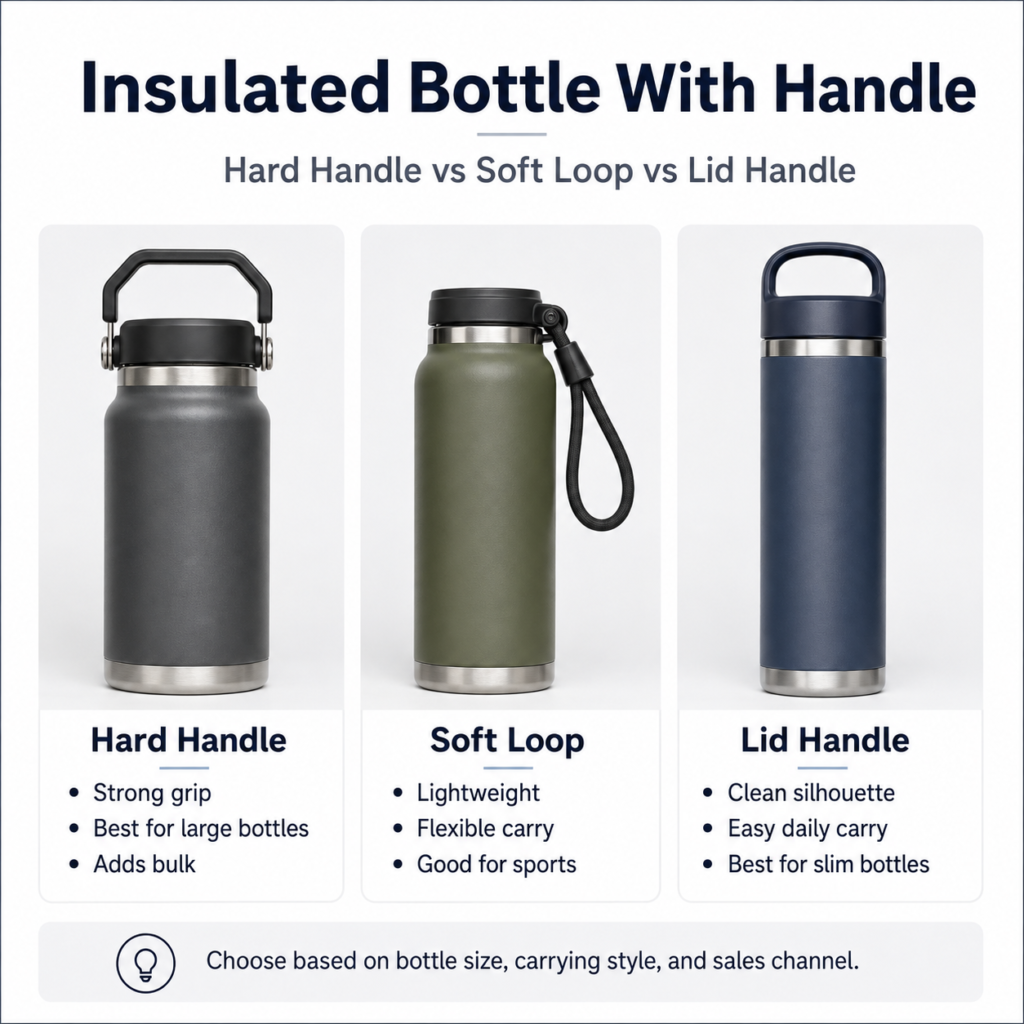
| Project Requirement | Better Handle Direction | Why |
|---|---|---|
| 32oz–40oz large-capacity bottle | Hard handle | Better grip under heavier filled weight |
| 500–750ml gym bottle | Soft loop | Lightweight and easy to carry |
| Slim commuter bottle | Lid handle | Cleaner shape and lower bulk |
| Outdoor / hiking bottle | Hard handle or strong loop | Better carrying control |
| Corporate gift bottle | Lid handle | Cleaner and more universal appearance |
| Kids bottle | Soft loop or compact handle | Easier for smaller hands |
| Retail shelf product | Lid handle or compact hard handle | Easier packaging and display |
| Premium sports product | Hard handle | Stronger visual and functional positioning |
| Low-MOQ first order | Existing lid handle | Lower development risk |
| Custom structural project | Hard handle or custom handle system | Better differentiation, but higher validation requirement |
The main rule is simple:
The heavier the filled bottle and the more active the use scenario, the more important handle strength becomes. The more lifestyle- or retail-focused the product is, the more important compactness and appearance become.
Hard Handle: Best When Carrying Strength Matters
A hard handle is usually a rigid plastic or metal-supported carry structure connected to the lid or upper bottle area.
It is common on:
- 32oz insulated bottles
- 40oz sports bottles
- 1L outdoor bottles
- large-capacity gym bottles
- camping bottles
- rugged lifestyle bottles
The biggest advantage of a hard handle is carrying confidence.
A 1L bottle filled with water adds approximately one kilogram of liquid weight before the weight of the stainless steel body and lid are included. When users repeatedly lift the bottle, the handle and lid connection experience much more stress than when the bottle is empty.
For this reason, hard handles are especially useful when the bottle is large or heavy.
They also make the product feel more functional. For outdoor, gym, sports, or utility-oriented brands, a visible rigid handle can become part of the product identity.
However, the advantages come with trade-offs.
Hard handles usually increase:
- product width
- lid complexity
- packaging volume
- mold complexity
- potential impact points
- assembly requirements
A hard handle may also interfere with cup holders, narrow bags, or compact retail boxes.
For buyers, the correct question is not only:
Does the handle look strong?
It is:
Can the handle support the bottle repeatedly when fully filled?
A physical sample should therefore be tested with water inside the bottle.
Hard Handle Buyer Checks
| Check Area | What Buyers Should Evaluate |
|---|---|
| Filled Weight | Can the handle support the real product load? |
| Grip Width | Is it comfortable for adult hands? |
| Pivot / Connection | Does the handle loosen after repeated use? |
| Lid Strength | Does carrying force deform the lid? |
| Drop Resistance | Does the handle crack after side impact? |
| Packaging | Does the handle increase box dimensions significantly? |
| Cup Holder Fit | Does the handle interfere with car use? |
| Surface Finish | Does the handle color match the bottle and lid? |
| Replacement | Can the handle or lid be replaced if damaged? |
| MOQ | Is the existing handle available without new tooling? |
A hard handle is often the better option for large bottles where carrying performance is part of the product value.
Soft Loop: Better for Lightweight and Flexible Carrying
A soft loop can be made from silicone, fabric, webbing, cord, TPU, or other flexible materials.
Compared with a hard handle, it adds less volume and usually creates fewer packaging problems.
Soft loops are common on:
- 500ml sports bottles
- 600ml–750ml gym bottles
- kids bottles
- travel bottles
- commuter bottles
- lightweight lifestyle products
A soft loop works well when the bottle does not need a large rigid grip.
It allows users to carry the bottle with one or two fingers, hook it to a bag, or hold it casually while walking.
For fitness and lifestyle products, this can feel more natural than a large rigid handle.
A soft loop can also reduce the visual heaviness of the lid. This matters when the brand wants a cleaner body shape but still needs a carrying feature.
For new brands, soft loops can sometimes be a practical way to create differentiation without redesigning the whole bottle structure.
However, the loop itself needs proper testing.
Buyers should check:
- stitching if fabric is used
- connection strength
- material elasticity
- odor
- color consistency
- wear after repeated carrying
- whether the loop twists around the lid
- whether the loop touches the drinking area
A soft loop that looks attractive in photos can feel cheap if the material is too thin or the attachment point is weak.
When a Soft Loop Makes More Sense
A soft loop is usually a better choice when:
- the bottle is 500–750ml
- weight needs to stay low
- the product is for gym or commuting
- compact packaging matters
- the bottle needs a sporty but not bulky appearance
- the buyer wants a lower-risk alternative to a large custom handle
For first-order OEM projects, an existing soft-loop lid can also be useful because the buyer can focus budget on Pantone color, logo, and packaging rather than structural development.
Lid Handle: The Lowest-Risk Option for Many New Brands
An integrated lid handle is usually molded directly into the cap or lid structure.
This is one of the most common options because it balances:
- portability
- clean appearance
- production maturity
- packaging efficiency
- lower development risk
Lid handles are widely used on:
- slim stainless steel bottles
- travel bottles
- corporate gift bottles
- school bottles
- retail bottles
- daily hydration products
For a new brand launching its first custom insulated bottle, an existing lid handle is often the safest option.
The structure is already established. The lid does not need a separate external handle assembly, and the packaging usually remains relatively compact.
This is especially useful for buyers ordering lower quantities.
For example, if the project uses an existing bottle and existing lid, the buyer can often keep the main customization focused on:
- stock or Pantone bottle color
- logo printing
- packaging
- accessories
Instead of spending time and budget on a new handle structure.
The downside is that an integrated lid handle may not provide the same comfortable grip as a large hard handle when the bottle becomes heavy.
For a 350–600ml bottle, that may not matter.
For a 1L or larger bottle, the user experience can become more important.
Lid Handle Works Best When
- bottle capacity is moderate
- the target market is daily hydration or commuting
- retail packaging needs to stay compact
- clean appearance matters
- the project has limited first-order quantity
- the brand does not need a highly differentiated structural design
In many OEM projects, lid handle = lower-risk starting point.
Bottle Capacity Should Influence Handle Selection
One of the most common mistakes is selecting the handle only by appearance.
Capacity changes the real carrying load.
Consider the difference:
| Bottle Capacity | Water Weight Only |
|---|---|
| 500ml | Approx. 0.5 kg |
| 750ml | Approx. 0.75 kg |
| 1L | Approx. 1.0 kg |
| 40oz / approx. 1.18L | Approx. 1.18 kg |
| 64oz / approx. 1.9L | Approx. 1.9 kg |
The final carrying weight is higher because the stainless steel bottle, lid, straw, silicone boot, and accessories also add weight.
That means a handle that feels acceptable on an empty showroom sample may feel completely different when the bottle is full.
For large-capacity insulated bottles, the buyer should evaluate:
- grip comfort
- finger space
- handle thickness
- handle angle
- attachment strength
- lid stability
This is why large outdoor and fitness bottles often use more substantial carry structures.
For smaller bottles, adding a large handle may actually make the product worse because the handle becomes visually oversized and increases packaging dimensions unnecessarily.
Buyer Scenario: Which Handle Fits Which Market?
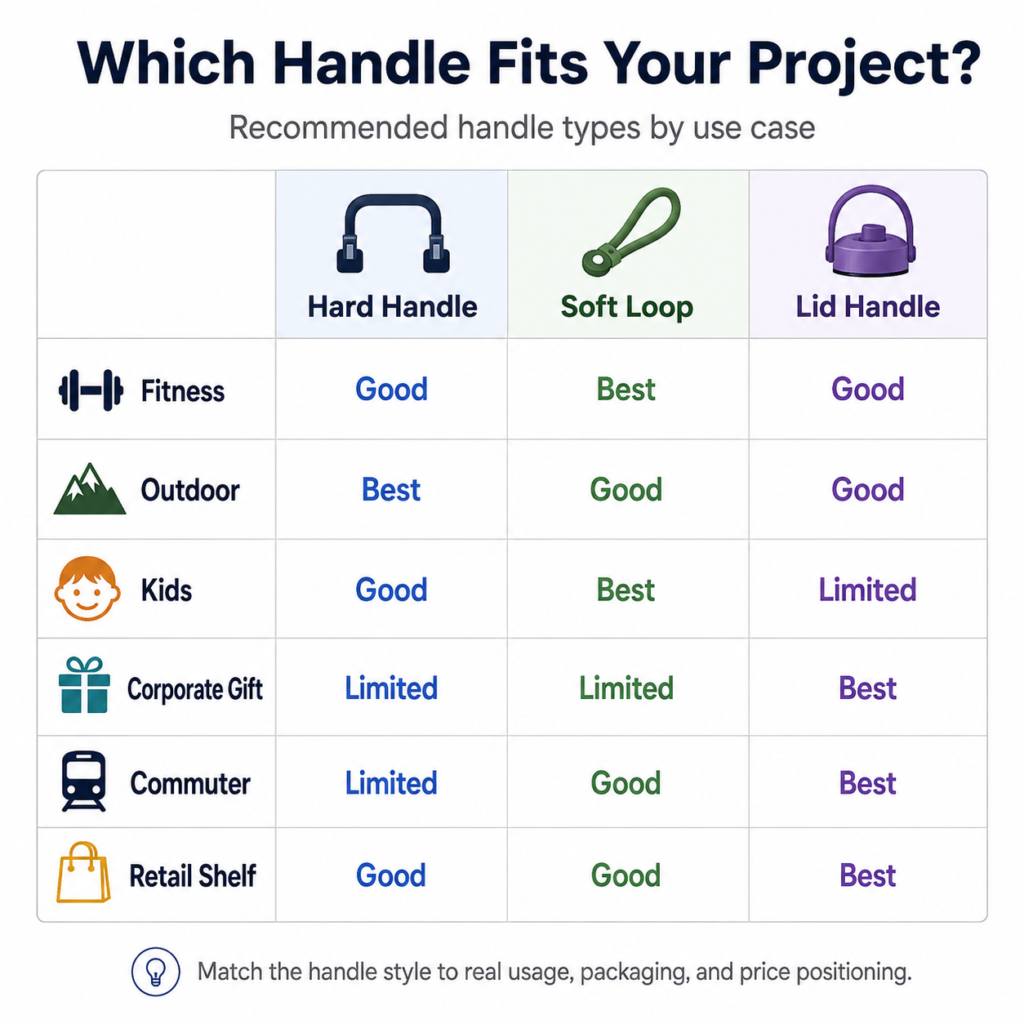
| Buyer Scenario | Recommended Handle | Main Reason |
|---|---|---|
| Fitness brand | Soft loop or hard handle | Active carrying and sporty positioning |
| Outdoor brand | Hard handle | Stronger grip and rugged use |
| Lifestyle brand | Lid handle or soft loop | Cleaner appearance |
| Corporate gift buyer | Lid handle | Universal and professional |
| Kids brand | Soft loop | Lightweight and easy to hold |
| Amazon seller | Proven existing handle | Lower review and development risk |
| Retail chain | Compact lid handle | Better shelf and packaging efficiency |
| Large-capacity hydration brand | Hard handle | Supports heavier filled weight |
| Promotional buyer | Existing lid handle | Controls cost |
| Premium sports brand | Hard handle | Functional differentiation |
There is no need to over-engineer a simple promotional bottle.
Likewise, a serious outdoor product should not use a weak handle just because it lowers cost slightly.
Handle Design Also Changes the Lid
The handle cannot be evaluated separately from the lid.
In many insulated bottles, the handle is attached directly to the lid. That means carrying force transfers into:
- the plastic lid body
- hinge areas
- pivot points
- lid threads
- locking structure
If the lid material or structure is weak, the handle may survive but the lid may crack.
This is why large handled bottles should be tested as a complete system.
A practical test sequence can include:
- Fill the bottle to normal capacity.
- Carry it repeatedly by the handle.
- Perform repeated lift cycles.
- Check the handle connection.
- Check whether the lid becomes loose.
- Repeat leak testing.
- Inspect the thread and gasket.
For products marketed as outdoor, gym, or rugged, a handle-side drop test can also be useful.
The goal is not simply to prove the handle does not break.
The goal is to confirm that carrying the bottle does not create new leakage or lid failures.
Packaging Is an Overlooked Handle Issue
Handles can change packaging cost more than buyers expect.
A bottle with a slim lid may fit into a narrow rectangular box.
Add a wide rigid handle and the box may need to become:
- wider
- taller
- differently shaped
- supported with an insert
This affects:
- unit box cost
- carton dimensions
- shipping volume
- retail shelf efficiency
- warehouse space
For corporate gifts or retail products, this matters because packaging is part of the selling value.
For promotional projects, unnecessary packaging volume can reduce cost efficiency.
Soft loops usually create the least packaging impact because they can fold or sit close to the bottle.
Integrated lid handles are also packaging-friendly.
Hard handles require more careful planning.
Example
Suppose two 1L bottles have similar body dimensions.
Bottle A uses a compact lid handle.
Bottle B uses a wide rigid carry handle.
Even if the bottle body cost is nearly the same, Bottle B may need:
- a wider box
- more internal protection
- larger carton volume
- higher freight cost per unit
This is why handle selection should be made before packaging artwork is finalized.
Handle Choice Can Affect Brand Positioning
The handle changes how customers interpret the product.
A large rigid handle often communicates:
- outdoor
- rugged
- sports
- high capacity
- utility
A soft loop often communicates:
- fitness
- lifestyle
- lightweight
- mobility
An integrated lid handle often communicates:
- clean
- practical
- daily use
- commuter
- gift-friendly
This matters for private label brands because two bottles with similar stainless steel construction can feel like completely different products simply because of the lid and handle.
The product should therefore match the brand position.
For example:
A premium gym brand may want a strong hard handle with a matte powder-coated body and laser logo.
A minimalist lifestyle brand may prefer a slim bottle with an integrated handle and small centered logo.
A kids brand may choose a soft loop with bright colors.
A corporate gift buyer may prefer the cleanest possible lid structure because it works across different recipients.
Recommended Route for Buyers
Route A — Lowest Risk
Existing bottle + existing lid handle
Best for:
- startups
- first orders
- corporate gifts
- lower MOQ projects
- fast market testing
Advantages:
- mature structure
- lower tooling risk
- easier packaging
- faster sample approval
Customization can focus on color, logo, and packaging.
Route B — Moderate Differentiation
Existing bottle + existing soft-loop or hard-handle lid
Best for:
- fitness brands
- lifestyle brands
- outdoor projects
- products needing stronger visual differentiation
This gives the brand more personality without developing an entirely new bottle.
Route C — Full ODM Development
Custom handle + custom lid or body structure
Best for:
- established brands
- high-volume projects
- exclusive designs
- products where the handle is a core selling feature
This route requires more development work because the handle may affect:
- mold design
- lid strength
- leak performance
- packaging
- drop resistance
- assembly
ODM new mold projects normally require a much higher order volume than standard OEM customization.
MOQ and Customization Planning
For standard ShinyStar Flask OEM projects, the common MOQ structure is:
| Customization | Typical MOQ |
|---|---|
| Stock bottle colors | 100 pcs per color |
| Custom Pantone bottle colors | 500 pcs per color |
| Custom lid colors | 1,000–3,000 pcs per color |
| ODM new mold / new structure | 3,000–5,000 pcs per color |
This is why a new brand wanting 100–200 bottles should normally choose an existing handle and lid structure.
Trying to create a completely new hard handle for a 100-piece project usually does not make commercial sense.
A better first-order approach is often:
existing model + suitable existing handle + custom logo + stock or Pantone color + branded packaging
Then, after the product proves demand, the brand can consider structural ODM development.
What to Prepare Before Requesting a Quote
To receive a useful quotation for an insulated bottle with handle, buyers should prepare:
- preferred bottle capacity
- target quantity
- target market
- intended use
- preferred handle type
- reference photo if available
- number of colors
- logo artwork
- packaging requirement
- destination country
- expected launch date
If the handle is part of a custom concept, also provide:
- sketch
- AI rendering
- 3D file if available
- dimensions
- expected carrying method
This helps the manufacturer determine whether the project can use an existing model or needs new development.
Common Mistakes Buyers Should Avoid
One mistake is choosing the biggest handle simply because it looks more premium.
A large handle may create unnecessary packaging and weight problems for a small bottle.
Another mistake is testing the bottle only when empty.
Handle performance should be checked with the bottle filled.
A third mistake is focusing only on handle strength and ignoring the lid.
Because the handle often connects to the lid, lid deformation can cause leakage even when the handle itself remains intact.
Another common mistake is developing a custom handle too early.
For a new brand, the first priority is usually validating:
- product demand
- capacity
- color
- branding
- packaging
- price point
A new custom handle can be added later if it creates meaningful differentiation.
Buyer Checklist
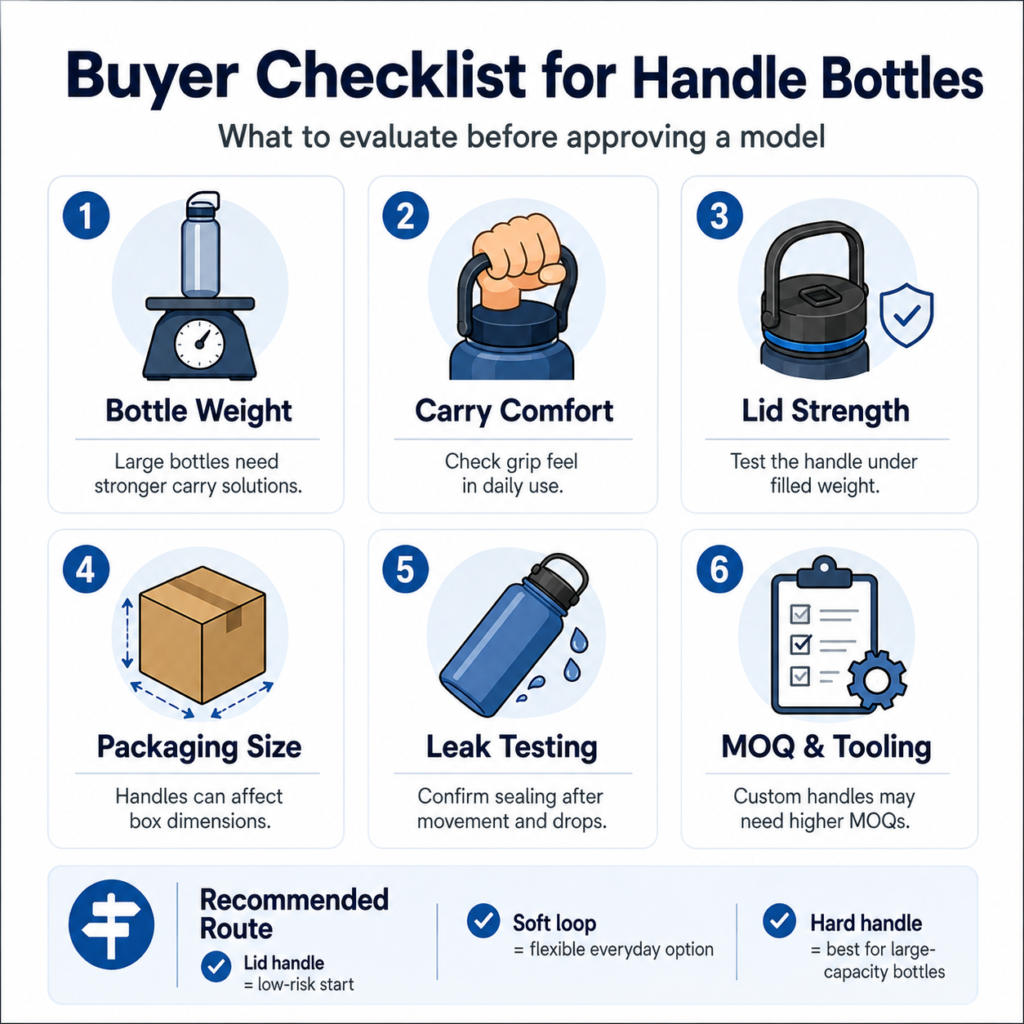
Before approving an insulated bottle with handle, confirm:
- capacity and filled weight
- handle type
- grip comfort
- handle attachment strength
- lid strength
- thread stability
- leak-proof performance
- drop resistance if required
- handle color
- body and lid color matching
- packaging dimensions
- retail shelf fit
- cup-holder compatibility
- MOQ
- tooling requirements
- replacement lid availability
FAQ
Is a hard handle better than a soft loop?
Not always. A hard handle is better for heavier bottles and outdoor use, while a soft loop is better when lightweight carrying and compact packaging matter.
What handle is best for a 1L insulated bottle?
For a 1L bottle, a strong hard handle or reinforced lid handle is usually more suitable because the bottle becomes significantly heavier when filled.
What handle is best for a 500ml bottle?
A compact lid handle or soft loop is often sufficient. A large hard handle may add unnecessary bulk.
Are handled bottles more expensive?
They can be. More complex handles may increase lid cost, packaging size, assembly, and tooling requirements.
Can a handle be customized in a Pantone color?
Yes, but custom plastic lid or handle colors normally require a higher MOQ than stock colors.
Can a new brand order only 100 handled bottles?
Yes, if using an existing bottle model and available stock lid or handle. Custom structural development is generally not suitable for such a low quantity.
Should handle bottles be drop-tested?
For outdoor, sports, kids, and large-capacity products, drop and handle-load testing is recommended.
Can the handle affect leak-proof performance?
Yes. If the handle transfers stress into the lid or thread, repeated carrying or impact can affect sealing performance.
Conclusion
Choosing an insulated bottle with handle is not simply a styling decision.
The handle affects carrying comfort, bottle weight, lid strength, packaging, shipping volume, product positioning, and long-term durability.
Hard handles are generally better for large-capacity bottles and outdoor or fitness products where strong carrying performance matters.
Soft loops are better when the bottle should remain lightweight, flexible, and easy to pack.
Integrated lid handles are often the safest option for new brands, corporate gifts, retail products, and lower-MOQ projects because they offer a good balance between portability and production simplicity.
The best approach is to start from the customer’s real use scenario.
If the bottle will be filled to 1L or more and carried during outdoor activity, handle strength should become a priority.
If the bottle is mainly for commuting, retail, or gifting, a compact handle may create a better overall product.
For first orders, proven existing handle structures usually provide the best balance of cost, speed, and risk control. Custom handle development becomes more valuable once order volume and market demand justify ODM investment.
Planning an insulated bottle with handle? Send us your target capacity, quantity, market, logo, and reference image. We can recommend suitable existing handle structures first, then determine whether custom development is actually necessary.
👉 Contact us for OEM stainless steel drinkware customization, logo printing, Pantone color matching, packaging solutions, and fast quotations for your next project.