For brands sourcing dishwasher-safe custom water bottles, the purchasing decision should begin with a defined product and a written verification plan. A stainless steel material specification, an attractive powder-coated sample or a supplier’s general statement cannot establish how the finished bottle will perform after repeated washing. The bottle body, decoration, lid, seals and accessories must support the same care instructions.
The practical question is: what evidence supports the claim for the exact combination you intend to sell? A plain bottle and a decorated version may need different evaluation. A new lid can change the scope. Even a successful test is difficult to use when the report does not identify the sample, washing conditions, observations and acceptance criteria.
This guide explains how OEM buyers can turn a dishwasher requirement into a manageable approval process. It covers specification, sampling, testing, evidence review and repeat-order control. It does not declare every stainless steel bottle dishwasher safe. At ShinyStar Flask, we recommend agreeing the requirement for the selected model and configuration before approving packaging or placing a production order.
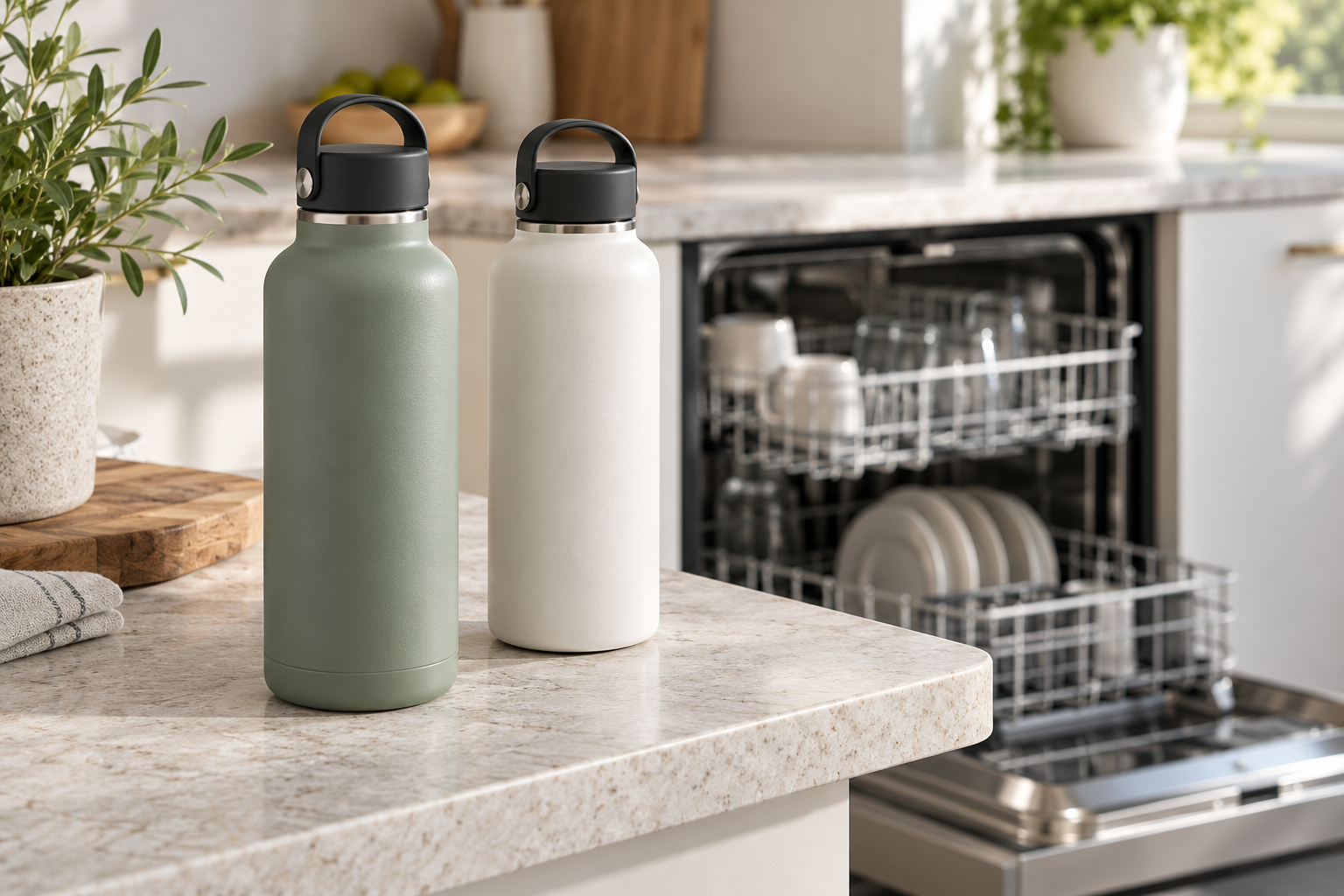
A buyer’s decision table before requesting samples
Start with the intended care statement. It determines which components belong in the evaluation and which instructions must accompany the product. These are planning routes, not performance classifications awarded by a test standard.
| Proposed care statement | Scope buyers should define | Approval evidence to request |
|---|---|---|
| Whole product is dishwasher safe | Finished body, decoration, lid and every included washable component | Results for the exact configuration and instructions for placement, disassembly and drying |
| Specified components are dishwasher safe | Each included component, with explicit exclusions | A component list and matching instructions on packaging and product listings |
| Top-rack dishwasher use only | Named components, rack position and any drying restrictions | Evaluation under the agreed restricted conditions |
| Hand wash only | Practical hand-cleaning access and durability under the stated routine | Usable cleaning instructions; no contradictory dishwasher icon or sales claim |
A restricted care statement can be appropriate when supported by evidence. The commercial problem arises when the supplier, packaging designer and sales team each communicate a different version. Resolve that difference before testing, because a report cannot repair unclear product requirements.
Define exactly what “dishwasher safe” means for your order
Identify the product configuration and its exclusions
Write down the bottle model, capacity, exterior finish, colour reference, decoration process, lid version, gasket specification and included accessories. Assign a revision to the combination. “The same bottle as last time” is not enough when the previous order used an undecorated surface or a different cap.
Next, state what the user may place in the dishwasher. Does the claim include the bottle body and lid? Must a silicone boot be removed? Is a strap excluded? Are the straw and removable gasket washed separately? An accessory included in the retail box can create expectations even when your purchasing team considers it optional.
Do not make the consumer infer these distinctions from several pages of instructions. A short statement on the packaging should agree with the fuller care guide and online listing. If only certain components qualify, name them. If evaluation supports only a restricted washing method, retain that restriction consistently.
Separate durability, cleanability and food-contact evidence
These are related purchasing questions, but they require different evidence. A product can be convenient to disassemble without having verified dishwasher durability. A coating can retain its appearance while a lid becomes difficult to operate. Food-contact documentation does not describe how well a printed logo survives a washing programme.
Build separate approval records for the intended cleaning method, the physical product’s durability, its functional performance and applicable food-contact requirements. Ask the selected laboratory which evaluations can be combined and which need different specimens or conditioning. Do not present a washing report as a substitute for every other product requirement.
For design access rather than washing endurance, our guide to easy-to-clean water bottle design covers openings, channels and removable parts. The focus here is the evidence needed to approve a care claim for an identified finished product.
Evaluate the finished product as a connected system
The bottle body and its decoration
A material name identifies only part of the product. Record the external finish and every operation applied over it, including a printed logo, wraparound artwork, clear finish or decorative insert. Evaluate the version customers receive, rather than relying only on a plain steel sample or a separate coated test panel.
Inspect the rim, shoulder, base and edges of the decoration as well as the central display area. A logo may remain readable while its edges begin to lift. Conversely, a finish can lose gloss without an obvious loss of colour. Decide which observations matter to the brand and how they will be recorded before samples are evaluated.
Our powder coating manufacturing guide explains production controls behind the finish. Dishwasher claim approval adds another question: whether the selected, decorated article retains the agreed condition and function under the defined cleaning exposure.
Lids, seals and optional accessories
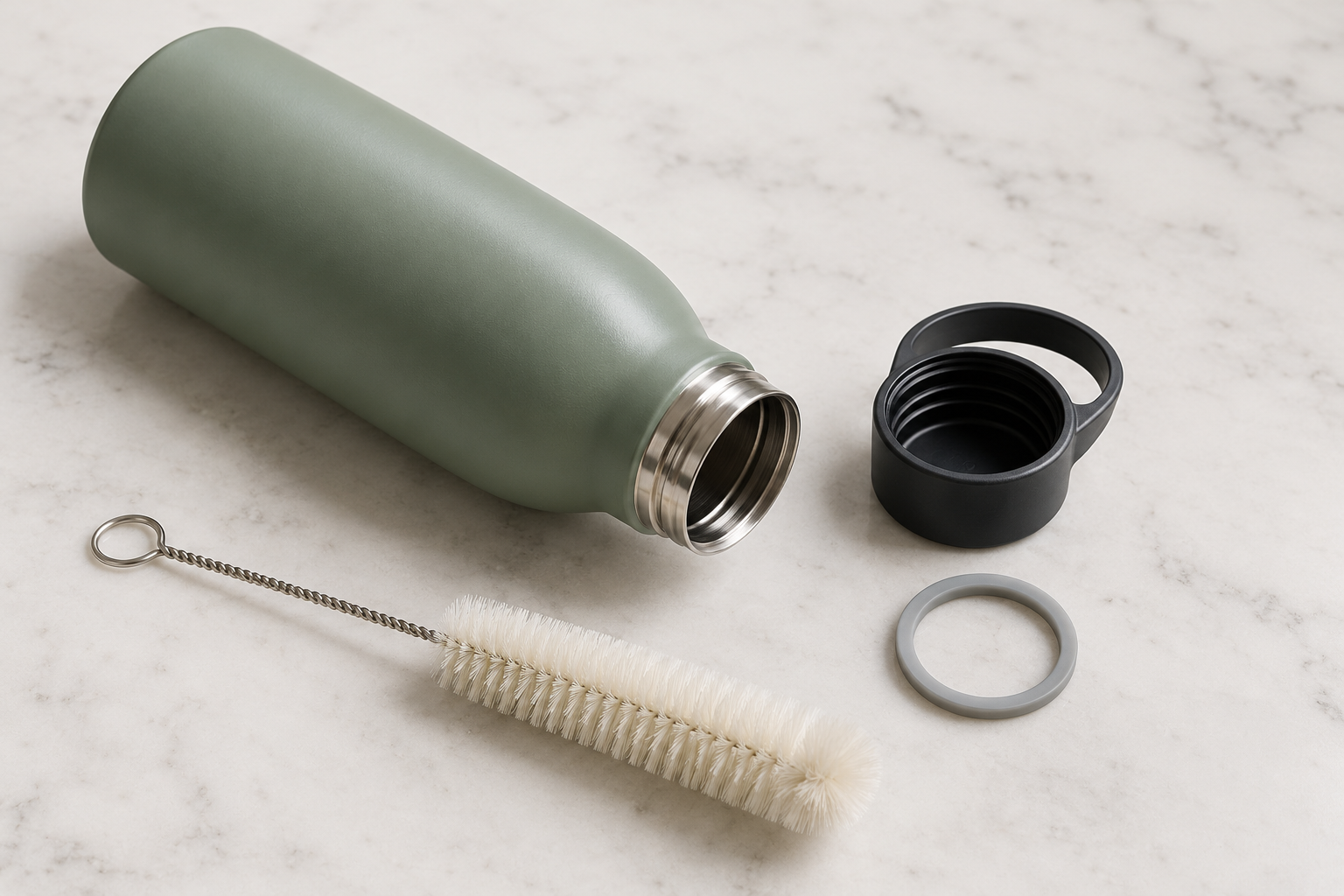
For a lid, approval should include more than its outside appearance. Check closure feel, thread engagement, operation of the drinking mechanism, gasket seating and reassembly after washing. Record whether a removable component still fits securely and whether a user can reinstall it correctly without specialist tools.
Keep accessories in a component matrix. Mark each item as included in the proposed claim, excluded, or awaiting evidence. A silicone boot, fabric strap and plastic straw are different components; inclusion in the same gift set does not establish identical care instructions.
Manufacturer instructions illustrate why this detail matters. YETI’s Rambler care page gives component-specific disassembly and reassembly instructions, including gasket removal and separate placement of parts. That is evidence about YETI’s specified products, not a transferable approval for another supplier’s bottle. Buyers should obtain instructions for their own selected construction.
Build a washing test brief before sending samples
A useful brief makes two things reproducible: the exposure and the decision. The laboratory or qualified test provider should be able to understand what was washed and under what conditions. A second reviewer should be able to see why the results met, or failed to meet, your agreed requirements.
Specify the exposure without inventing a universal cycle count
Record the machine or test apparatus, programme, detergent, dosage approach, water conditions, rack location, orientation, disassembly routine, drying stage and total exposure. Ask the laboratory to confirm which variables its selected method controls and which project-specific details must be added.
There is no cycle number in this guide that automatically approves every bottle. A buyer’s internal endurance target and a recognised test method are different things. If your retailer requests a particular method or minimum exposure, provide that requirement to the laboratory instead of replacing it with a factory’s informal wash trial.
BSI lists BS EN 12875-1:2005 as a reference test method for domestic articles in the mechanical dishwashing resistance series. That listing helps identify a relevant discussion with a laboratory; it does not establish that every drinkware configuration falls within a particular claim or has passed. Confirm the applicable edition, scope and reporting requirements with the test provider.
Specify samples, comparison controls and checkpoints
Agree how many samples are needed and why. Include the combinations that matter commercially: finish, decoration, lid and any higher-risk variation identified by the supplier or laboratory. Record which samples undergo washing and retain unexposed comparison samples from the same preparation batch where practical.
Set observation checkpoints before the work begins. Intermediate observations help distinguish gradual appearance change from a sudden functional problem. Photographs should use consistent lighting, viewing angle and background, with a sample identifier visible in the record. A photograph that flatters one surface and exaggerates another is a weak basis for approval.
| Brief field | What to record | Why it changes the decision |
|---|---|---|
| Sample identity | Model, component revisions, finish, artwork and preparation batch | Connects the result to the sellable configuration |
| Washing exposure | Method, equipment, programme, detergent, loading and drying | Makes the exposure interpretable and repeatable |
| Disassembly | Parts removed, orientation and reassembly procedure | Defines the user routine that the claim requires |
| Observation plan | Baseline, checkpoints, comparison samples and photographs | Separates initial variation from changes during washing |
| Acceptance criteria | Appearance limits, functional requirements and reportable defects | Prevents pass/fail decisions from changing after results arrive |
| Exceptions | Deviations, interrupted exposure, repairs or replaced components | Shows when the outcome needs qualification or further work |
Ask for the brief to be reviewed before samples leave the factory. This avoids paying for an evaluation that measures a convenient property while missing the question behind your proposed sales claim.
Agree measurable appearance and functional acceptance criteria
Use a defect description rather than “looks acceptable”
Describe what reviewers will look for: peeling, blistering, cracking, colour change, gloss change, corrosion-like marks, blurred decoration, lost text, deformation and insecure assembly. Separate cosmetic observations from functional failures. A small cosmetic change may still be unacceptable for a premium gift, while an apparently clean lid can fail a closure requirement.
Where a numerical colour or gloss limit is needed, agree the instrument, measurement location, specimen preparation and limit with the test provider. For visual criteria, agree reference photographs, lighting and the viewing method. Do not attach a precise number to a property that nobody has defined how to measure.
Consider the information carried by the decoration. A decorative pattern and essential care wording serve different purposes. If washing makes an instruction unreadable, the issue is broader than appearance. Include the relevant text, markings or labels in the sample review rather than testing an attractive simplified version.
Keep adhesion checks in their proper role
ASTM D3359 describes tape-based methods for rating coating adhesion to metallic substrates. It is an adhesion assessment, not a complete dishwasher endurance qualification. A suitable adhesion result can support a wider investigation, but it cannot replace the agreed washing exposure and post-wash review.
Discuss specimen geometry and destructive testing with the laboratory. A curved decorated bottle is not interchangeable with every flat test panel. If an adhesion evaluation damages the surface, plan the specimen sequence so that the damage does not unintentionally change a later washing or functional test.
The same principle applies to informal rubbing or scratch checks. They can be useful development screens when described honestly, but passing one screen does not establish an unrestricted dishwasher claim. Keep the test name, purpose and conclusion connected in the report.
Check performance after washing and reassembly
Define functional checks relevant to the product: lid operation, seal fit, leak behaviour, handle security and, for an insulated model, the agreed insulation assessment. Record the baseline first. Otherwise, a difference after washing may be confused with normal sample-to-sample variation or an initial defect.
For any leak evaluation, define the fill condition, closure procedure, orientation, duration and acceptance criterion. Use the product’s intended beverage and temperature restrictions. Do not improvise a hazardous hot-liquid test or assume a straw lid is suitable for every use. Have the supplier or qualified provider establish a controlled procedure appropriate to the design.
If a gasket must be removed for washing, assess the product after realistic reassembly. This exposes a different problem from material damage: instructions may be too ambiguous for users to return the product to its intended configuration. A correct result from a technician who already knows the mechanism may not answer that usability question.
Read the report against the product you intend to buy
Begin with the specimen description, not the word “pass”. Match the model and photographs to your approved sample. Confirm the colour, decoration, lid and included components. Then check the method, exposure, observations, acceptance criteria and any deviations. Ask what the reported conclusion actually covers.
A report on an earlier version may be relevant background, but it needs a documented link to the current article. Have the supplier explain changes and the laboratory assess whether they affect applicability. Do not silently extend a result from one lid or decoration to a collection of different products.
If a report covers several variants through a justified selection, retain the selection rationale. Which variations were considered? Which were evaluated? What evidence supports grouping them? “Same material” alone is an incomplete explanation when construction, processing or decoration differs.
Keep the approved specimen, report, artwork revision and final care wording together. A purchasing team should be able to retrieve this package during a reorder or customer question without reconstructing the project from old email attachments. Record who approved the claim and which sales channels will use it.
Turn sample approval into production and reorder controls
Identify changes that need a fresh review
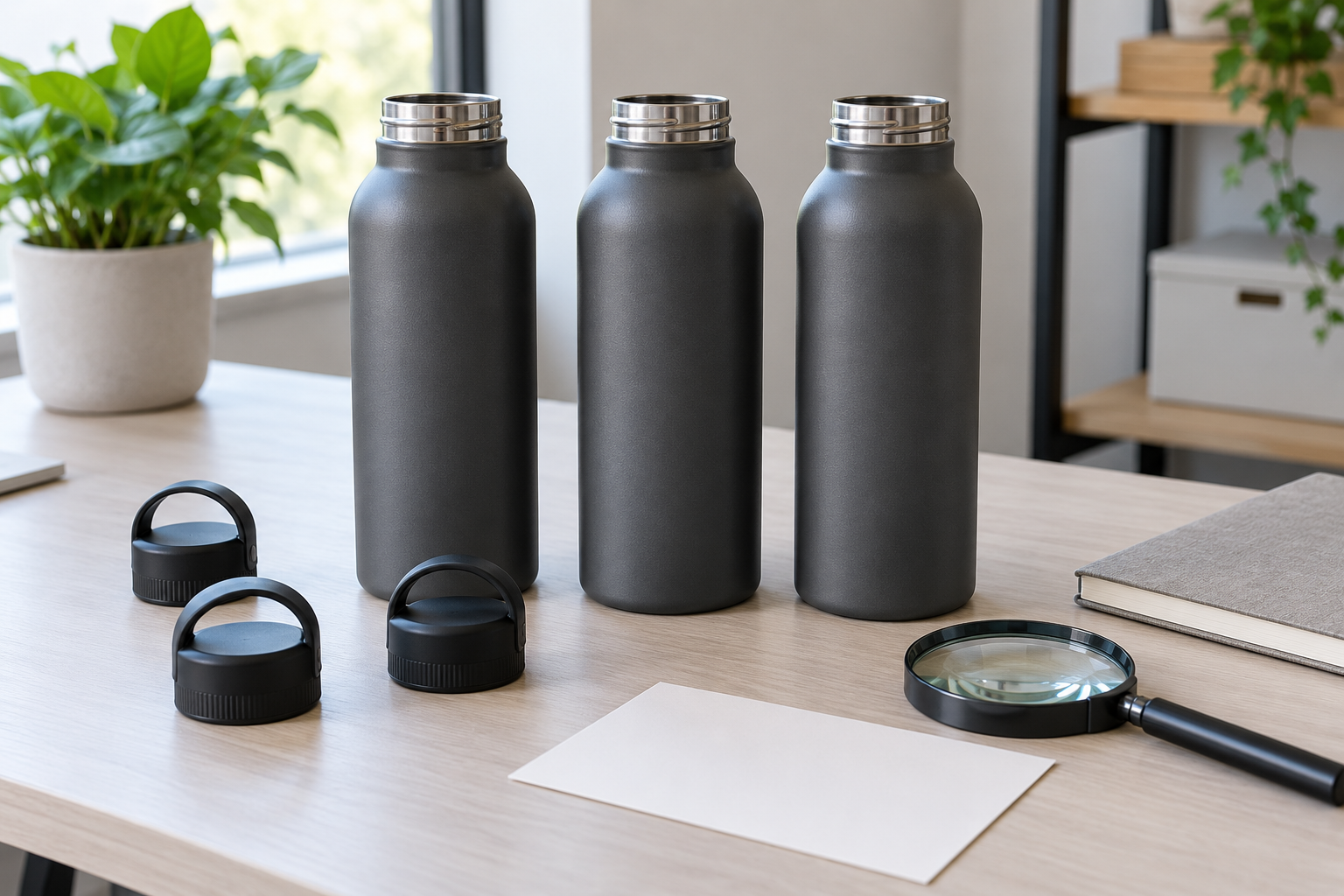
A successful development sample is a starting point for production control. Ask the supplier to identify the materials, components and processes that were used for the approved configuration. Record the versions clearly enough that a later change can be recognised before shipment.
Examples worth reviewing include a new coating formulation, a different decoration system, revised curing conditions, a changed plastic or gasket specification, a new component supplier or a redesigned lid. These changes do not all demand the same response. They do require a competent decision about whether previous evidence remains applicable.
Agree a notification process. The factory should know which substitutions require buyer review before implementation. The buyer should know who can approve them and what evidence is needed. A change that improves cost or availability can still affect the basis of an existing care statement.
Separate production inspection from claim qualification
Pre-shipment inspection can check whether delivered products match the agreed specification and defect criteria. It does not automatically reproduce the full endurance evaluation. Set a realistic inspection scope, identify any retained production samples and agree when further testing is required.
For repeated orders, compare the new build against the approved configuration. Review customer feedback as another input, especially repeated reports about coating change, logo readability or lid operation after washing. Feedback is useful evidence for investigation, but a complaint alone does not establish its cause.
Use a traceable investigation rather than immediately changing every care statement. Identify the affected batch, confirm the actual consumer routine where possible, inspect returned samples and compare production records. If the claim or instructions need revision, coordinate the change across packaging, listings and future shipments.
A hypothetical private-label project: approve the build before the claim
Consider a hypothetical fitness brand ordering a matte bottle with a printed logo, a screw lid and a removable silicone boot. The supplier has a previous washing report for an undecorated version. The brand wants to print “dishwasher safe” on the retail box.
The first step is to identify the difference between the reported sample and the proposed retail product. The logo and boot are additional variables. The team should also confirm that the lid and gasket match the version described in the earlier report. The report might inform the project, but it does not by itself settle the new claim.
The buyer then asks the supplier and laboratory to review a finished sample set and propose an evaluation covering the intended routine. The team agrees whether the boot is included, how parts are disassembled, which washing exposure applies and which post-wash observations determine acceptance.
Suppose development screening raises a concern about the printed logo. There are several possible commercial responses: review the decoration process, evaluate a different finish and decoration combination, restrict the proposed care method if evidence supports that route, or retain hand-wash instructions. None of these options is automatically approved by this example.
The selected route should be reflected in the quote and schedule. It may require new samples, evaluation time or packaging artwork changes. Those costs are easier to manage before printing boxes than after the sales team has promised an unsupported feature to retailers.
For a wider product brief, our private-label water bottle manufacturing page explains the customisation options to discuss. Dishwasher suitability should be treated as a specific project requirement within that brief, with evidence matched to the chosen product.
Plan the cost and timing of verification
Request a separate line for development samples, testing, report preparation and any additional samples required after changes. Do not assume that a standard sample quote includes a claim-validation programme. Ask the provider to identify what happens if an initial configuration needs revision.
Sequence the project so that final care wording follows the evidence review. Packaging design can proceed in parallel, but irreversible print approval should reflect the accepted product and instructions. Build in time for the buyer, supplier and laboratory to resolve a result that is unclear or outside the agreed criteria.
There is no universal test price or lead time stated here. The model, number of configurations, evaluation method, laboratory workload and required reporting affect the programme. Ask for these details in the project quotation rather than assuming a generic dishwasher claim adds no cost or time.
RFQ checklist for dishwasher-safe custom water bottles
Send the supplier a clear initial brief. You do not need to design the laboratory method yourself, but you should define the commercial requirement and request a written technical proposal.
- Target market, sales channel and intended user.
- Selected model, capacity, finish, colour and decoration artwork.
- Exact lid, gasket and accessory combination.
- Proposed care statement and any component exclusions.
- Retailer or laboratory requirements already supplied to your team.
- Requested sample selection and explanation of variant coverage.
- Proposed appearance, marking-readability and functional criteria.
- Need for baseline records, retained samples and a complete report.
- Packaging approval deadline and allowance for sample revisions.
- Production change-notification and reorder review requirements.
Ask the supplier to identify existing evidence and gaps separately. That distinction lets the buyer decide what can be relied on, what needs clarification and what remains to be evaluated. It also prevents a generic factory presentation from being mistaken for approval of a particular retail SKU.
Frequently asked questions
Are all 304 stainless steel water bottles dishwasher safe?
No blanket conclusion follows from the steel grade. A sellable bottle includes construction details, exterior finishes, decoration and closure components. Define the exact configuration and proposed washing routine, then request appropriate evidence. If a supplier provides a material document, use it for the property it addresses; do not treat it as a complete finished-product washing report. The same approach applies when comparing 304 with another stainless steel grade.
Can powder-coated bottles carry a dishwasher-safe claim?
Some finished products can support that claim, but “powder coated” alone does not establish it. Evaluate the specific finish and decorated article under the agreed conditions. Hydro Flask’s own care guidance distinguishes between product versions and ranges rather than assigning one washing rule to every product. Such manufacturer instructions demonstrate the importance of product-specific scope; they do not certify another factory’s coating or bottle.
Does laser engraving automatically make the whole bottle dishwasher safe?
No. Selecting a decoration method does not settle the performance of the coating, body, lid, seals or accessories. Buyers can discuss laser engraving as an option, but the finished configuration still needs review against the proposed claim. Ask what the decoration evaluation covers and what other observations remain necessary. Avoid turning a preference for one logo process into a promise about every component in the box.
How many dishwasher cycles should buyers specify?
Agree the exposure with the selected laboratory and any relevant customer or retailer. The required number depends on the method and purpose of evaluation; a cycle count without conditions and acceptance criteria is incomplete. An internal screening target should be labelled as such. It should not be described as a recognised certification or an unrestricted lifetime guarantee simply because a factory completed that many washes.
Can one tested colour represent the entire collection?
That requires a justified assessment. Give the provider the proposed colour, finish and decoration variations, including any process differences. Ask which variants should be evaluated and whether grouping is appropriate. Retain the written rationale and the limits of coverage. If the report identifies only one sample, do not assume it covers every colour or future special finish without further review.
Is a food-contact report enough to support the care claim?
It answers a different set of questions. Review the food-contact requirements applicable to the product and intended market separately from washing durability. Ask the laboratory how repeated-use or conditioning requirements affect the overall evaluation plan. A care claim should have evidence addressing that claim, while the compliance file should contain the documents required for the selected materials, components and use conditions.
What should happen if the decoration passes but the lid fails?
Do not approve the whole configuration on the strength of the decoration result. Document the failed function and investigate the relevant component and procedure. The project may need a revised lid, seal specification, instruction or care requirement, followed by appropriate review. If the claim is narrowed, make the distinction explicit across packaging and listings. A successful result for one component does not cancel another component’s failure.
Can ShinyStar Flask confirm dishwasher suitability before quotation?
Share the intended product, finish, logo method, lid, accessories and target care statement. We can review the requirement with the selected configuration and identify what evidence is available or needs to be arranged. Model-specific suitability, evaluation scope, cost and timing must be confirmed for the project. We do not apply a blanket dishwasher-safe promise to every custom bottle, colour or component combination.
Approve a supported claim, then keep the product consistent
The most useful purchasing outcome is a clear connection between the product, the evaluation and the promise made to customers. Define the complete configuration, agree the washing exposure and acceptance criteria, review the report against the real sample, and retain the approved instructions with the product records.
After approval, maintain that connection through production and reorders. Material, decoration or component changes should trigger an appropriate review before previous evidence is reused. Packaging and online copy should continue to describe the configuration actually supplied.
For your next project, send ShinyStar Flask the bottle style, quantity, finish, logo artwork, lid and proposed care statement through our quote and sample enquiry page. We can use that brief to discuss product options and the evidence needed before approving dishwasher-safe wording for your order.
Primary references and further reading
The sources below support the descriptions of published methods and manufacturer-specific care instructions. They are not test evidence for ShinyStar Flask products. Consult the relevant provider for the complete method and its applicability to your project.