
The cost to manufacture a stainless steel water bottle depends on its construction, material specification, capacity, lid, finish and order quantity. For custom orders, the buyer must also account for branding, packaging and any separate development or setup charges. There is no useful universal unit price without a defined product configuration.
For a brand or importer, the practical starting point is the supplier’s quotation for a complete bottle. Confirm what that price includes before adding other expenses. If the quotation already covers powder coating, one logo and an individual box, adding those items again would overstate the budget. If they are excluded, the advertised bottle price will understate the amount needed to complete the project.
It is equally important to distinguish manufacturing cost from the amount paid to receive the goods. A factory’s internal production cost, its selling price and the buyer’s delivered project cost are different figures. Freight, inspection, testing and other applicable charges may sit outside the quoted product price.
This guide explains how to assess stainless steel water bottle manufacturing costs from a purchasing perspective. It focuses on reusable drinkware sourced for brands, wholesalers, promotional campaigns and retail programmes. It does not cover the cost of manufacturing disposable bottled water or building a bottle production plant.
Rather than presenting an unsupported price range, the following sections show which specifications influence the quotation, how quantity and customisation interact, and how to build a clear budget. A worked example uses explicitly hypothetical figures to demonstrate the calculation. Those figures are not current market prices or a ShinyStar Flask quotation.
The objective is to help buyers move from a general question—“How much does a bottle cost?”—to a specification that a manufacturer can price accurately and that several suppliers can quote on a comparable basis.
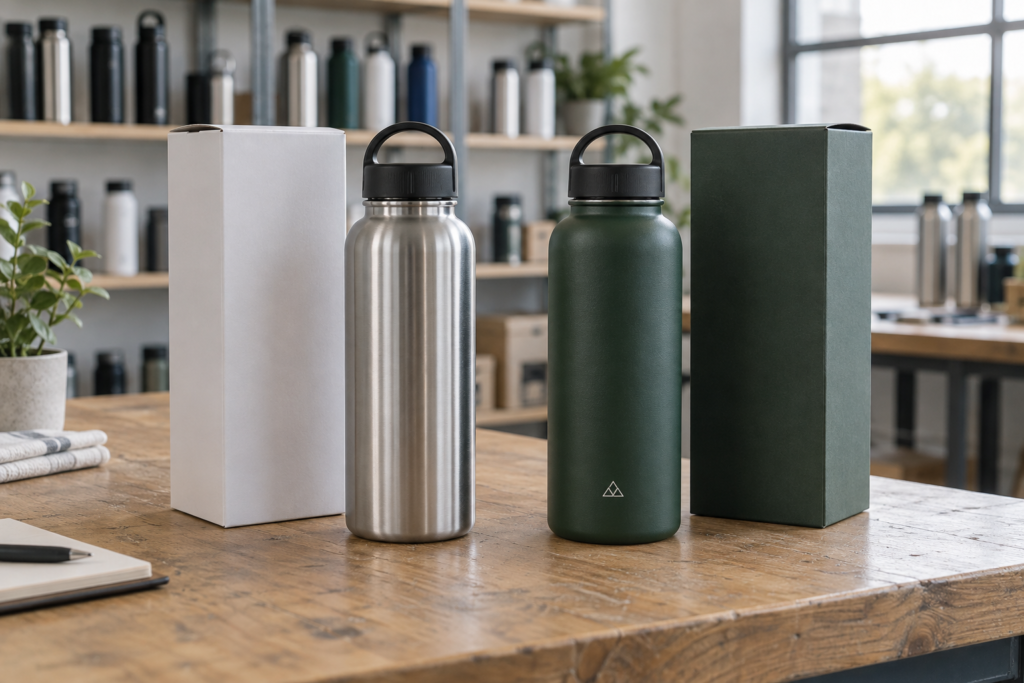
Manufacturing Cost, Factory Price and Landed Cost
Before comparing figures, identify what each figure represents. The word “cost” is often used loosely in supplier discussions, even though the underlying scope can differ substantially.
Manufacturing cost
Manufacturing cost refers to the producer’s costs associated with making the product. Depending on the accounting approach, this can include materials, components, labour, production overhead and other manufacturing expenses.
A buyer normally does not receive a complete view of the factory’s internal cost calculation. An externally published breakdown assigning fixed percentages to steel, labour and profit should therefore not be treated as the actual economics of a particular supplier.
For sourcing decisions, understanding the factors that affect production is usually more useful than attempting to infer an exact factory margin.
Factory selling price
The factory selling price is the commercial price offered for the specified goods under stated conditions. It is not simply the cost of steel plus an assembly charge.
The quotation should identify the configuration, quantity, included decoration, packaging and delivery basis. It may include certain services or setup costs within the unit price, while other items appear separately.
The term “factory price” alone is incomplete. Buyers should ask which costs and delivery responsibilities are included rather than assuming that the phrase means the same thing in every quotation.
Landed cost and project budget
Landed cost generally concerns the cost of bringing goods to a defined destination, but budgeting practices differ. State the destination and list the included expenses whenever using this term.
A broader project budget may also include development samples, photography, additional testing or other launch expenses that are not part of the bottle shipment itself.
For clear comparison, keep four categories visible:
| Cost category | Examples | How to handle it |
|---|---|---|
| Per-unit product charges | Bottle, lid, finish, logo and individual packaging | Confirm which items are included in the quoted unit price |
| One-time project charges | Tooling, development or certain setup fees | List separately unless explicitly included |
| Order or batch services | Samples, agreed testing or third-party inspection | Budget according to the actual service scope |
| Transport and destination expenses | Freight, handling and applicable import-related charges | Confirm the delivery scope and avoid overlapping charges |
This structure helps buyers compare quotations without confusing production expenses with the complete purchasing budget.
What Determines the Bottle’s Unit Price?
Two bottles with similar photographs can have different specifications. Before judging a price difference, check the construction, dimensions, component materials and intended performance.
The relevant comparison is between complete configurations, not just similar silhouettes.
Single-wall and vacuum insulated construction
A single-wall bottle and a double-wall vacuum insulated bottle involve different structures and production requirements. Vacuum insulated construction adds an inner vessel, outer shell and operations associated with establishing and checking the insulating space.
That difference matters, but it does not establish a fixed price relationship between every single-wall and insulated product. Size, finish, lid and production scale can also affect the result.
Buyers should choose the construction around the application. If temperature retention is a core product requirement, it belongs in the specification from the beginning.
Material specifications and bottle dimensions
Identify the material requirements for the inner liner, outer shell and relevant lid components. A description such as “stainless steel bottle” does not provide enough detail for a meaningful comparison.
Capacity, diameter, height, body geometry and specified wall thickness can influence material usage and processing. They can also affect packaging and transport volume.
A heavier bottle is not automatically a better purchase, and a lighter bottle is not automatically unsuitable. Compare the weight alongside structural requirements, sample evaluation and the intended use.
Lid construction and accessories
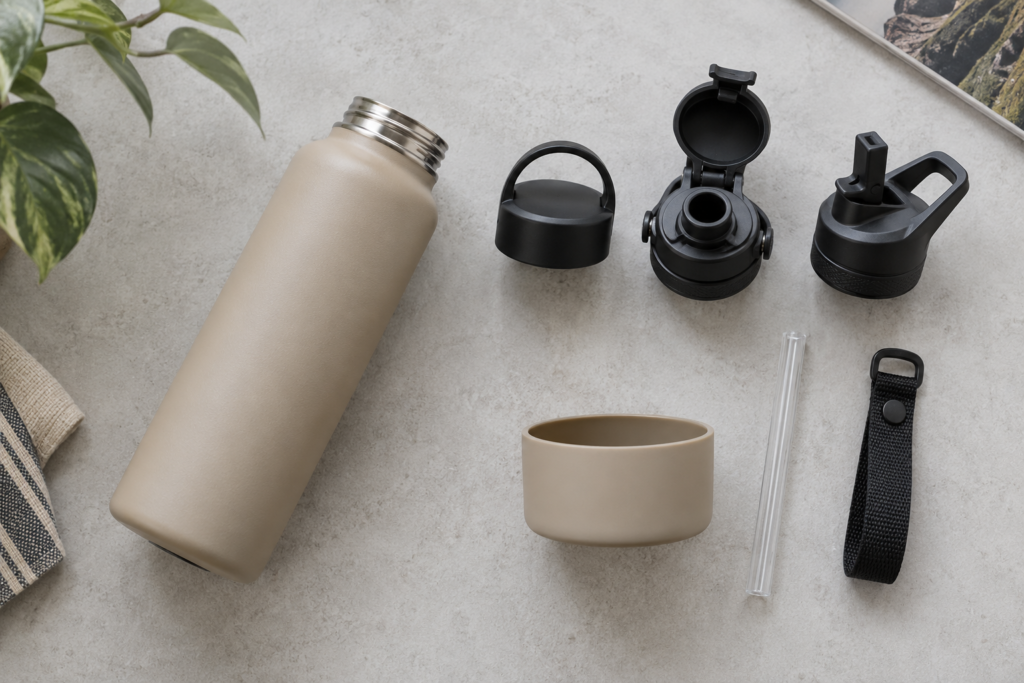
The lid can be an important source of price variation. A simple screw cap, a multi-part drinking lid and a closure with additional mechanisms require different components and assembly work.
Extra lids, silicone boots, straps, brushes and other accessories also change the supplied configuration. Confirm whether they are included in the bottle price or quoted separately.
Performance and inspection requirements
Buyers may require particular leakage, thermal, finish or durability performance. Those requirements can influence product selection and the work needed to validate the configuration.
Do not compare a fully specified project with a loosely described bottle and assume the difference is only supplier margin. Our stainless steel water bottle manufacturing guide explains the production stages behind these purchasing decisions.
How Customisation Changes the Cost
Customisation affects more than the visible appearance of a bottle. Colour, artwork, finish and packaging can introduce preparation work, different components and separate minimum quantities.
To receive a useful quotation, describe the desired result in enough detail for the supplier to identify the actual operations.
Stock colours and custom colour matching
An available stock colour can simplify a project when it meets the brand’s requirements. A custom colour may involve matching, sample approval and a dedicated production arrangement.
The quotation should identify the finish as well as the colour. A matte textured surface, a glossy finish and a special decorative treatment should not be treated as interchangeable options.
Where colour accuracy matters, approve a physical reference under agreed conditions. A screen image is useful for discussion but may not establish the final appearance.
Logo size, position and method
The cost of applying a logo depends on the artwork and selected process. Relevant details include dimensions, number of colours, print locations, coverage and the surface receiving the decoration.
A small single-position logo is a different requirement from a multi-colour wraparound design. The preparation and production implications should be assessed against the actual artwork.
For a method comparison, see our guide to screen printing, heat transfer and laser engraving.
Packaging and presentation
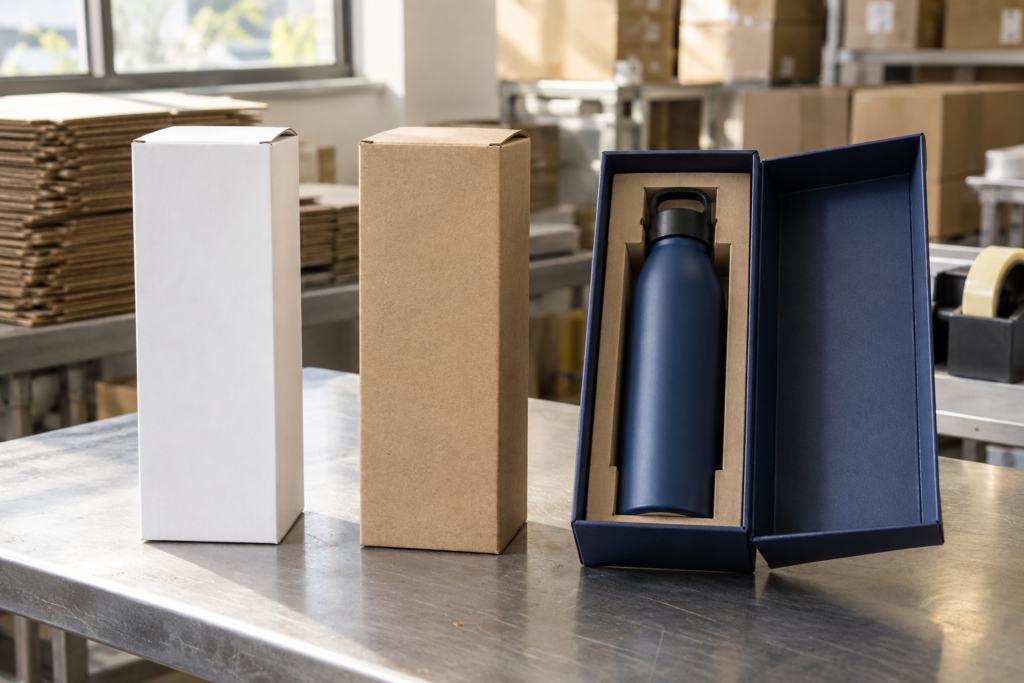
Basic protective packaging, a printed retail box and a structured gift box serve different purposes. Additional inserts, accessories and printed materials can alter both the packaging price and shipment dimensions.
Confirm whether packaging is priced per unit, subject to a separate minimum quantity or associated with a setup charge.
| Purchasing choice | What may influence the quotation | What to confirm |
|---|---|---|
| Stock or custom colour | Availability, matching and production preparation | Colour reference, finish and quantity per colour |
| Small logo or extensive artwork | Decoration method, coverage and print positions | Final artwork size and placement |
| Standard or specialised finish | Materials, application and validation requirements | Approved appearance and intended care conditions |
| One lid or an accessory set | Component count, assembly and packing | Exact contents of each unit |
| Basic box or gift packaging | Structure, printing, inserts and dimensions | Packaging specification and minimum quantity |
The aim is to price the desired configuration once, with clear inclusions, rather than collecting unrelated add-on estimates.
How Order Quantity and Colour Allocation Affect Pricing
Order quantity can influence unit pricing, but the total number of bottles is only part of the picture. Manufacturers also need to know how the order is divided by model, capacity, colour and decoration.
An order for 1,000 identical bottles is different from an order containing five models in several colours, even if both purchase orders show the same total quantity.
Total quantity versus production quantity per variant
Production preparation and component sourcing may occur at the variant level. Dividing an order into smaller groups can affect efficiency and the ability to meet minimum quantities for particular finishes or packaging.
For example, 1,000 bottles in one stock colour should not automatically be priced the same as 1,000 bottles split across five custom colours. The supplier needs the allocation before confirming the quotation.
Ask for the MOQ at the level that matters: per model, per capacity, per colour or per packaging design.
Request useful quantity tiers
Quantity tiers should reflect realistic purchasing scenarios. A new brand might compare an initial trial order with a larger replenishment order. An established buyer might request pricing for several shipment quantities under the same specification.
Keep the configuration constant across the tiers. Otherwise, it becomes difficult to see whether a price change results from volume or from a different product.
A tiered quotation should also state any assumptions about delivery timing and order release.
Treat annual volume separately from one shipment
An anticipated annual purchase volume may support a commercial discussion, but it is not necessarily equivalent to placing the full quantity in one order.
Monthly deliveries can involve different production, storage, scheduling and payment arrangements. Ask the supplier to explain the conditions attached to annual-volume pricing.
At ShinyStar Flask, selected existing models can start from 100 pieces per stock colour, while custom Pantone colours generally start from 500 pieces per colour. The actual requirement depends on the selected model, finish and packaging.
Our guide to insulated water bottle MOQ provides further context. The right order quantity should balance unit pricing with expected demand and the buyer’s ability to manage the stock.
Existing Models vs Custom Mould Development
One of the largest differences between projects is whether the buyer selects an existing model or develops a new structure.
These routes should have separate budgets. Adding a logo to an existing bottle is not commercially equivalent to developing a new body, lid or drinking mechanism.
Customising an existing model
An existing model may support changes to colour, branding, packaging and compatible accessories without requiring new bottle-body tooling.
This route can reduce the development work needed, but buyers should still confirm sample charges, decoration preparation and any minimum quantities. “Existing model” does not mean every modification is possible without additional cost.
The supplier should identify which features are available as standard options and which changes require technical review.
Developing a new body or component
A new shape, opening dimension, lid mechanism or other structural feature may require design work, tooling, prototypes and validation.
The budget should distinguish the development stages. Ask what each payment covers, which samples are included and how modifications will be handled.
A single number labelled “mould fee” may not explain the full scope. It could exclude related tooling, revised samples or additional components required to complete the product.
Agree ownership and future use
For custom tooling, confirm ownership, permitted use, maintenance arrangements and any conditions affecting future production. If a tooling refund or credit is offered, document the qualifying quantity and other terms.
Do not treat a future refund as a reduction in the cash needed at the beginning of the project. It is a separate commercial condition until the requirements are met.
Evaluate the business reason for development
New tooling can be appropriate when the product needs meaningful structural differentiation. It may be unnecessary when a brand’s requirements can be met through an existing model and well-chosen customisation.
Before commissioning development, compare the proposed benefit with the additional budget, approval stages and expected purchase volume. The most suitable route is the one that supports the product plan with a manageable level of investment.
What Is Included in a Supplier’s Quotation?
A useful quotation is a description of the supplied product and commercial scope, not just a unit price.
Before comparing suppliers, check whether they have priced the same model, components, decoration, packaging and quantity. If a quotation leaves an item unspecified, ask for clarification instead of assuming it is included.
Establish the base configuration
The quoted bottle should be identifiable through a model number, drawing, specification or reference image. Record its capacity, materials, lid and finish.
The quotation should also describe the logo application and individual packaging. If these are optional, request separate clearly labelled alternatives.
A photograph alone may not show whether an extra lid, straw, protective boot or accessory is included.
Separate included and additional charges
Ask which sample, setup, testing and inspection expenses are already covered. Avoid assuming that all quality-related services are free or that they must all be charged separately.
Routine factory checks and an independently commissioned inspection are different services. Their scope should be clear before costs are added to the budget.

| Comparison item | Questions to ask |
|---|---|
| Bottle specification | Are capacity, materials, construction and dimensions comparable? |
| Lid and accessories | Is the same closure configuration included? |
| Finish | Is the quotation for the same colour, texture and coating? |
| Logo | Are method, dimensions and print positions defined? |
| Packaging | Is the individual box and any insert included? |
| Quantity allocation | Are the same quantities per model and colour being quoted? |
| Samples and setup | Which charges are separate, included or potentially credited? |
| Testing and inspection | What work is included, and what requires an additional service? |
| Delivery scope | Where does the supplier’s quoted responsibility end? |
| Commercial conditions | What are the currency, validity period and payment terms? |
Record the assumptions that could change the price
A quotation may need revision if artwork, quantity allocation, packing or delivery requirements change. Keep the approved version with the sample and specification records.
For repeat orders, verify whether the previous configuration is still available and whether the quotation remains valid. An earlier purchase provides a reference, but it is not a permanent price commitment.
A Worked Budget Example for a Custom Bottle Order
The following example demonstrates how to organise a budget. All figures are hypothetical and are not current market prices, freight estimates or a ShinyStar Flask offer.
Assume a buyer is considering 1,000 existing-model vacuum insulated bottles in one available colour. The hypothetical unit price includes one standard lid, one agreed logo application and basic individual packaging. No new mould is required.
Calculate the quoted goods value
| Item | Hypothetical calculation | Amount |
|---|---|---|
| Complete customised bottles | 1,000 × US$4.00 | US$4,000 |
| Sample charge | Separately quoted | US$100 |
| Sample delivery | Separately quoted | US$50 |
| Decoration setup | Separately quoted | US$80 |
| Optional independent inspection | Separately arranged | US$250 |
| Subtotal before transport and destination charges | Sum of the above | US$4,480 |
The product value is US$4,000. The broader subtotal is US$4,480 because the example includes several separately charged items.
Dividing that subtotal by 1,000 produces a budget allocation of US$4.48 per ordered bottle. This is not a landed unit cost, because freight and destination expenses have not been included.
It is also not the factory’s manufacturing cost. It is a buyer-side allocation of the hypothetical expenses shown.
Add only the expenses outside the quotation
The next stage is to obtain the shipment quotation and confirm its scope. Add transport and other applicable expenses only where they are not already included.
Any additional product testing would also need a separately confirmed scope and charge. Do not insert a generic testing allowance and present it as a verified quotation.
The calculation is:
Project budget = quoted goods value + separate project charges + applicable transport and destination expenses not already included.
Review what changes on a repeat order
Suppose the same hypothetical order is repeated and the supplier confirms that the sample, sample delivery and decoration setup charges do not recur. If every other figure remains unchanged, the comparable subtotal would be US$4,250.
That reduction is a calculation under the example’s assumptions. Actual repeat-order pricing still depends on the quotation, specification and services required.
Need a budget for your own configuration? Send the bottle style, capacity, quantity and customisation requirements through our quotation enquiry page. We can identify the product options and confirm which costs belong in the proposal.
Shipping, Inspection and Other Project Costs
The bottle’s quoted price does not necessarily show the amount needed to complete the purchasing project. Additional expenses should be identified early, particularly when the buyer is comparing proposals with different delivery scopes.
Avoid applying a general per-bottle freight figure without knowing the packed shipment dimensions, quantity, destination and service requirements.
Shipping depends on the packed order
Transport quotations should be based on the actual packing arrangement or a clearly identified preliminary estimate. Carton dimensions, gross weight and shipment volume can change when the buyer adds accessories or upgrades the packaging.
A larger gift box may affect more than packaging cost. It can also change carton quantities and the space occupied during transport.
Ask whether the freight proposal includes collection, handling, delivery and other relevant services. Record exclusions so they are not discovered only after the order is ready.
Testing and inspection depend on scope
Testing costs depend on the product configuration, requested assessment and service provider. The number of materials, colours or components involved may affect the work required.
Similarly, a third-party inspection should be budgeted against the actual location, timing and inspection scope. Do not assume that a fixed charge per bottle applies across different order sizes.
Confirm whether testing is required before production, before shipment or at another stage, since timing can affect the overall schedule.
Destination expenses require specific information
Applicable import-related charges depend on the destination, product classification and current requirements. A broad percentage should not be copied across the United States, Canada, European countries and Australia.
Have the relevant service provider confirm the treatment for the actual shipment. For budgeting, list each confirmed charge and its scope rather than hiding everything inside an unexplained allowance.
Our guide to estimating the total cost of importing reusable water bottles is a related starting point for organising those questions.
How to Reduce Costs Without Weakening the Product
Cost reduction is most useful when it removes unnecessary complexity while preserving the requirements that matter to the customer.
Begin with the product brief. Identify which features are essential to the brand proposition and which are preferences that can be adjusted.
Start with an appropriate existing model
An existing bottle can often meet the required capacity, appearance and use conditions. Review available options before commissioning a new structure.
A suitable standard model with distinctive colours and branding may provide enough differentiation for the first product launch. New development can then be assessed against actual sales experience.
Simplify variants where practical
Reducing the number of models, capacities or colours can simplify an initial order. It may also make stock management easier.
This should not be done mechanically. Keep variants that have a clear commercial purpose, and remove those added without a realistic demand plan.
Ask the supplier to quote alternatives so the effect of consolidation is visible.
Match decoration to the artwork
A complex decoration process is not always necessary to achieve the intended design. Discuss the artwork with the supplier and compare suitable methods.
Consider whether fewer print locations, a revised logo size or a different placement can produce the desired result more efficiently. Evaluate the physical sample rather than choosing solely from a list of decoration prices.
Design packaging around the sales channel
Packaging should protect the product and support its presentation. Extra layers or oversized boxes may add expense without improving either function.
Review the bottle, accessories and packaging together. A more efficient arrangement can improve both packing and transport use.
Preserve the agreed functional requirements
Do not remove required sealing, material or quality checks simply to reach a target price. Instead, ask which product configuration can meet the budget and intended use.
For example, our guide to leaking stainless steel water bottles explains why bottle-and-lid compatibility matters. A lower purchase price is less attractive if an unsuitable closure creates avoidable returns or replacements.
Buyer Checklist and Common Quotation Mistakes
A clear brief reduces the number of assumptions in a quotation. It also helps suppliers suggest practical alternatives when the first configuration does not fit the budget.
Before requesting prices, prepare the model or reference image, capacity, quantity allocation, colour, logo, lid and packaging requirements. Add the destination and required timing.
Comparing different specifications as though they are identical
Similar product photographs can conceal differences in components, finishes or packaging. Use a written specification when comparing proposals.
If a supplier suggests an alternative, record what changes and why. An alternative may be worthwhile, but it should remain identifiable as a different offer.
Adding costs that are already included
Check the inclusions before building the budget. Logo printing, coating or basic packaging may already be covered by the product price.
The same applies to transport-related services. A cost worksheet should identify each item once, with its source and scope.
Treating future credits as immediate savings
Sample credits or tooling refunds may depend on conditions. Keep the upfront payment visible and record any future credit separately.
Only update the budget when the applicable conditions and treatment are confirmed.
Buying more solely to obtain a lower unit price
A lower price at a larger quantity does not automatically justify the additional purchase. Consider expected sales, stock flexibility and the total cash commitment.
Request realistic tiers and choose the quantity that supports the business plan.
Forgetting the cost of late changes
Revised artwork, a new colour or different packaging can affect preparation and sample approval. Confirm the consequences before authorising changes.
Retain the final approved specification so production does not proceed using an outdated version.
Using an expired quotation as a current price
Check the validity period, currency and commercial conditions. For a delayed or repeat order, ask for confirmation before relying on the earlier amount.
A complete quotation is a dated offer for a defined scope, not a permanent reference price for all future orders.
Frequently Asked Questions
How much does it cost to manufacture a stainless steel water bottle?
There is no single reliable figure without a specification. Construction, capacity, materials, lid, finish, quantity and packaging all influence the quotation. For purchasing purposes, request the price of a complete configuration and identify separate project expenses. A generic production-cost estimate is not a substitute for a supplier offer.
Why can two similar bottles have different prices?
Their internal materials, dimensions, closure components, finishes or included services may differ. Quantity allocation and packaging can also affect the quotation. Compare the specifications and inclusions before deciding whether the difference reflects a more suitable offer, a different product or a different commercial scope.
Does ordering more always reduce the unit price?
A larger quantity may improve pricing, but the result depends on the product and how the order is divided. Several small custom-colour batches are different from one larger identical batch. Request quantity tiers for the same configuration and assess the total purchase commitment as well as the unit price.
Is adding a logo cheaper than developing a new bottle?
Customising an existing model generally avoids the body-development work associated with a new structure. However, the actual project still needs a quotation for decoration, samples and packaging. New lids or other structural modifications may introduce tooling even when the bottle body already exists.
Are sample charges refundable?
That depends on the supplier’s offer. Some charges may be credited against a qualifying order, while others remain separate. Confirm the required quantity, timing and eligible charges in writing. Keep the initial sample payment in the budget until the credit conditions have been met.
Is packaging included in the bottle price?
Sometimes basic packaging is included, but this must be stated in the quotation. Printed retail boxes, gift boxes, inserts and accessory packs may be priced separately. Confirm both the individual pack and the outer-carton arrangement, especially if the packaging changes shipment dimensions.
Will a repeat order cost less than the first order?
Some development or setup expenses may not recur, but a lower total is not guaranteed. Product pricing, quantity, component availability and requested services can change. Ask for a repeat-order quotation that identifies which earlier charges no longer apply and confirms the current configuration.
What information should I send to get an accurate quotation?
Provide a bottle image or model number, capacity, total quantity and quantity per colour. Include the lid, colour or finish, logo artwork, packaging requirements and destination. State the required timing and any performance or testing requirements. If the model is undecided, explain the intended use and target budget.
Build the Budget Around a Complete Specification
A useful stainless steel water bottle cost estimate starts with a defined product and a quotation that explains its inclusions. The bottle body, lid, decoration and packaging should be considered together, followed by any separate samples, development, testing, inspection and delivery expenses.
This approach makes supplier comparisons clearer. It also reveals where a project can be simplified without removing the features or performance that matter to the customer.
For an initial order, focus on a configuration that meets the intended use and can be purchased in a manageable quantity. For repeat programmes, maintain the approved specification and review pricing against realistic order releases. A clear purchasing brief creates a stronger basis for cost control than a broad price range detached from the product.
Request a Custom Water Bottle Quotation
ShinyStar Flask supports stainless steel water bottle projects with model selection, colour and logo customisation, lid options and packaging.
To receive a quotation, send:
- A preferred model or reference image.
- Required capacity.
- Total quantity and quantity per colour.
- Colour, finish and logo requirements.
- Lid and accessory preferences.
- Packaging requirements.
- Destination and required timing.
If you have not selected a model, share the intended use and target budget. We can recommend suitable options, confirm the applicable MOQ and provide a quotation with the relevant inclusions and separate charges.