For B2B buyers sourcing insulated bottles, tumblers, travel mugs, and large-capacity hydration products, cup holder compatibility is easy to overlook during product selection.
A bottle may have the right capacity, attractive lid, premium powder coating, strong insulation, and competitive pricing—but if the base is too wide for common vehicle cup holders, customers may quickly become dissatisfied.
This matters especially for:
- commuter drinkware
- travel mugs
- fitness bottles
- 30oz and 40oz tumblers
- lifestyle hydration brands
- automotive promotional products
- retail drinkware collections
The key mistake is checking only the bottle’s maximum body diameter.
For cup holder fit, buyers need to look at the base diameter, taper angle, bottle height, handle position, center of gravity, and actual filled weight.
A 40oz tumbler may have a wide upper body but still fit many vehicle cup holders because the lower section is tapered. A straight-wall 1L bottle with a smaller visual profile may actually be less compatible if its base remains wide.
For OEM buyers, this means cup holder compatibility should be confirmed before approving the product shape, handle, silicone boot, and packaging.
The correct question is not simply:
“Does this bottle fit a cup holder?”
It should be:
“Which cup holders, what base diameter, and what use scenario is this bottle designed for?”
Buyer Decision Snapshot
| Product Requirement | Better Direction | Why |
|---|---|---|
| Daily commuter tumbler | Tapered base | Better vehicle compatibility |
| 30oz–40oz handled tumbler | Narrow lower base + wide upper body | Maintains capacity without oversized base |
| Straight 1L sports bottle | Check base carefully | Large capacity may create a wide footprint |
| Outdoor bottle | Cup holder fit may be secondary | Backpack and handle use can matter more |
| Corporate travel mug | Compact base | Works across more users and vehicles |
| Gym bottle | Moderate base diameter | Can fit both equipment holders and car use |
| Kids bottle | Slim base | Easier for small holders and backpack pockets |
| Silicone boot version | Recheck finished base diameter | Boot can increase external width |
| Custom handle design | Check handle clearance | Handle may interfere with vehicle console |
| New ODM shape | Validate with physical samples | CAD dimensions alone may not reflect actual user experience |
A useful sourcing rule is:
If vehicle use is part of the product positioning, base geometry should be treated as a core product specification—not a minor detail.
Why Cup Holder Fit Matters More Than It Looks
Cup holder compatibility directly affects how customers use a bottle every day.
A consumer may use the same drinkware product:
- at home
- in the office
- at the gym
- in the car
- while commuting
- during road trips
If the bottle works well everywhere except the car, the user may still consider the product inconvenient.
This is particularly important for brands selling 30oz and 40oz tumblers.
Large-capacity drinkware became commercially attractive partly because brands found ways to combine:
- high volume
- large handle
- straw lid
- narrow car-compatible base
Without the tapered lower body, the same capacity would create a much wider footprint.
For retail brands, this feature can also influence product messaging.
Terms such as:
- car-friendly
- commuter-friendly
- cup-holder compatible
- travel-ready
can add perceived value.
But buyers should be careful with broad claims.
Vehicle cup holders are not standardized to one universal size. Different cars, countries, center-console designs, and cup holder shapes vary.
A manufacturer should therefore avoid promising that one bottle fits “every car cup holder.”
A more practical product-development goal is:
design the base to fit a broad range of common vehicle holders while keeping the bottle stable and comfortable to use.
Base Diameter Is the Most Important Measurement
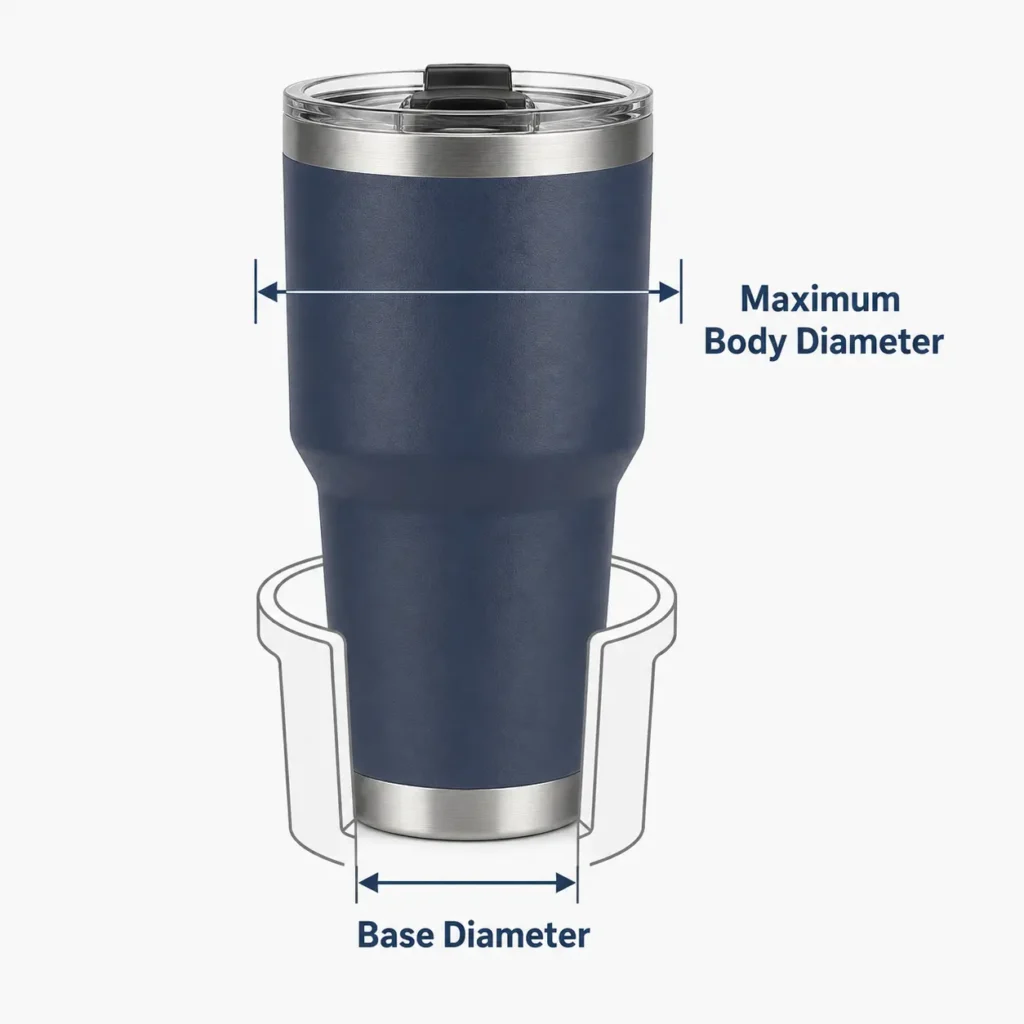
When discussing water bottle cup holder fit, the first dimension buyers should request is the base diameter.
This is different from the maximum bottle diameter.
Consider two bottle designs.
Bottle A:
- maximum body diameter: 100mm
- base diameter: 72mm
- tapered lower section
Bottle B:
- maximum body diameter: 85mm
- base diameter: 85mm
- straight wall
Although Bottle A looks much wider, it may fit more vehicle cup holders because the lower section is narrower.
This is why catalog photos can be misleading.
A buyer looking only at product width may reject a large tumbler that actually fits a car well—or select a straight bottle that later proves inconvenient.
What Buyers Should Request
For cup-holder-related projects, request:
- base diameter
- maximum body diameter
- taper starting point
- total height
- handle projection
- bottom boot thickness
- finished diameter with accessories installed
These dimensions should be checked on the final configuration, not only the stainless steel body.
If a silicone boot is added later, the bottle may become wider at the exact area that enters the cup holder.
Tapered vs Straight Bottle Bodies
Body shape is one of the biggest design decisions affecting cup holder compatibility.
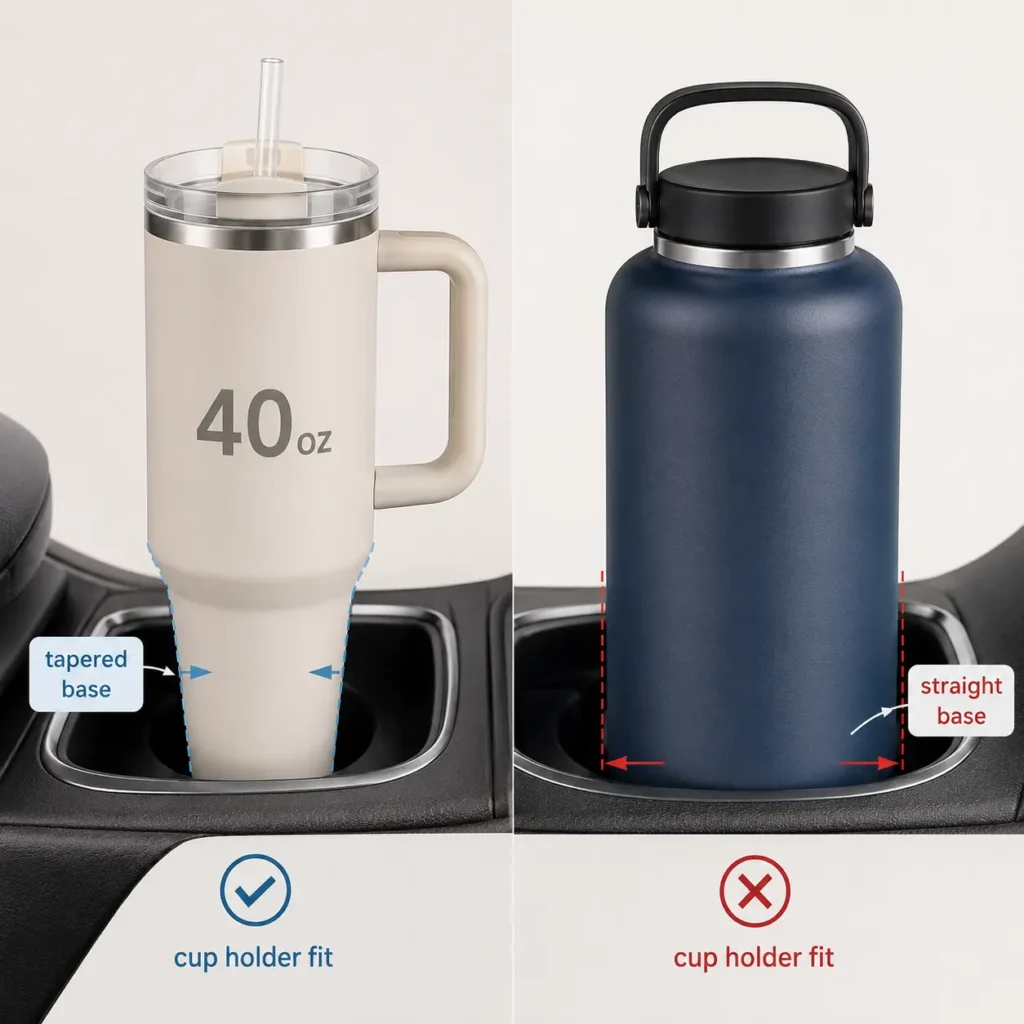
Tapered Body
A tapered bottle becomes narrower toward the bottom.
This structure is commonly used for:
- 30oz tumblers
- 40oz tumblers
- handled car tumblers
- commuter drinkware
The main advantage is clear:
high capacity without an equally large base.
The upper body can remain wide enough to provide volume while the lower section fits more vehicle consoles.
However, tapered bodies create other considerations.
They may:
- require different packaging geometry
- feel top-heavy
- need stronger bottom stability
- limit some printing areas
- create more complex shape transitions
For large handled tumblers, the handle helps compensate for the wider upper body during use.
Straight Body
Straight-wall bottles maintain almost the same diameter from top to bottom.
They are common for:
- sports bottles
- outdoor bottles
- slim vacuum flasks
- school bottles
- lifestyle bottles
The shape is visually clean and often provides good logo space.
But cup holder compatibility depends heavily on the actual diameter.
A 75mm straight bottle may work well.
A 90mm straight bottle may not.
So “straight” does not mean incompatible—it simply means the base is less forgiving.
Body Shape Comparison
| Feature | Tapered Body | Straight Body |
|---|---|---|
| Cup Holder Fit | Usually better for large capacities | Depends directly on body diameter |
| Large Capacity | Strong advantage | Can become very wide |
| Logo Area | Slightly more limited at lower body | Large uniform branding area |
| Stability | Can be more top-heavy | Usually balanced |
| Car Use | Strong | Good if diameter is controlled |
| Outdoor Use | Good | Often strong |
| Packaging | Shape may require more space | Usually easier |
| Visual Positioning | Lifestyle / commuter | Sports / outdoor / minimal |
The right choice depends on the product’s market, not only aesthetics.
Handle Position Can Create a Second Compatibility Problem
Even when the base fits perfectly, a handle can still interfere with the vehicle console.
This is especially relevant for large handled tumblers.
Possible issues include:
- handle touching the side of the console
- handle blocking a second cup holder
- handle preventing the bottle from sitting fully inside the holder
- handle colliding with gear controls or storage compartments
- handle making the bottle difficult to remove
This is why a 40oz tumbler should not be evaluated only from the front.
The manufacturer should also check the side profile.
For handled drinkware, buyers should request:
- base diameter
- handle width
- handle projection from body
- distance between handle bottom and bottle base
- total bottle width including handle
The handle does not necessarily need to fit inside the cup holder.
It needs enough clearance above and around the vehicle console.
Factory Reality
A small change in handle position can make a large difference.
For example, moving the lower handle attachment slightly higher may allow the bottle to sit deeper inside the cup holder.
But that change can also affect:
- ergonomics
- mold structure
- visual balance
- handle load
- overall height
For existing OEM products, it is usually safer to choose a proven bottle-handle combination rather than modifying the handle location for a small order.
Silicone Boots Can Change Cup Holder Compatibility
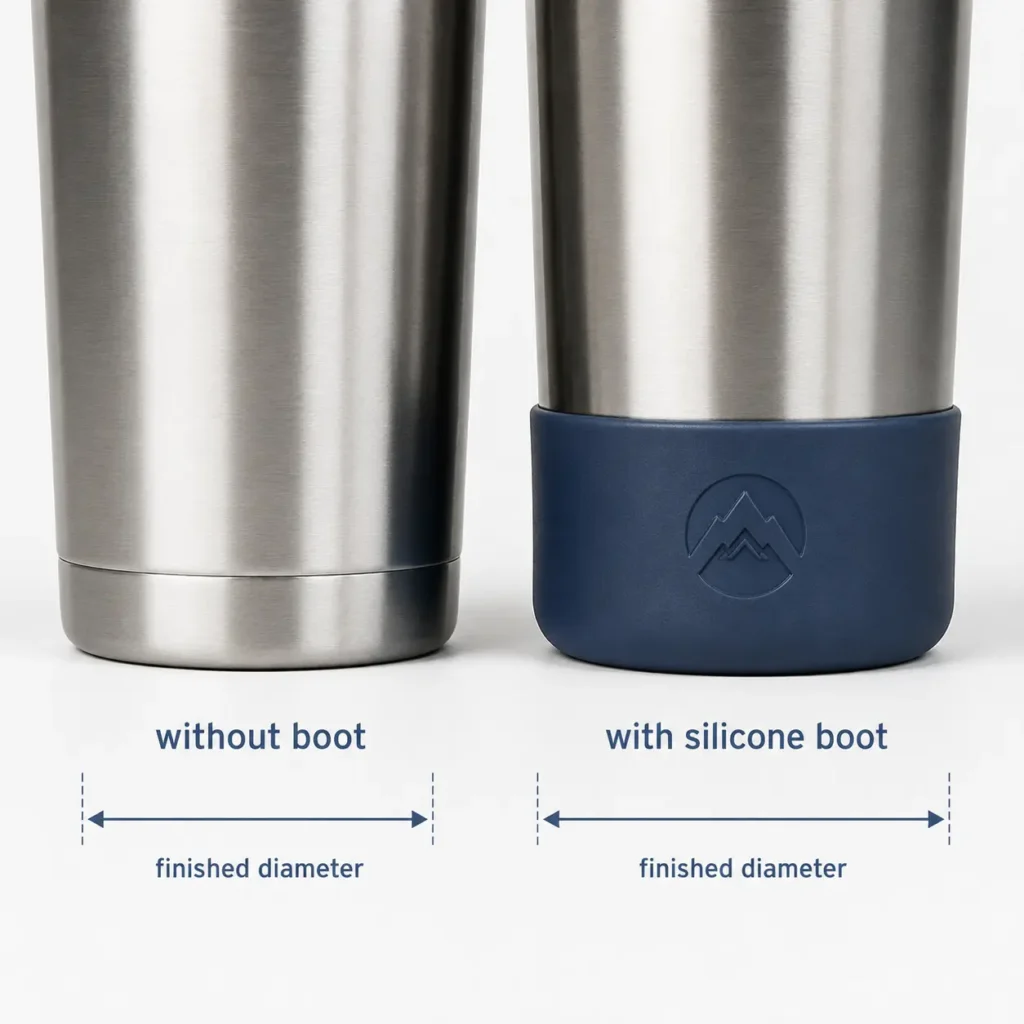
Silicone boots are popular because they can:
- protect the bottle base
- reduce noise
- reduce scratches
- improve grip
- add a brand color accent
But they also change the final outside diameter.
Suppose the stainless steel base is 72mm.
After adding a silicone boot, the final external diameter may become several millimeters larger.
That difference may sound small, but it can matter when the bottle is already close to the practical limit of a cup holder.
This is especially important for:
- 30oz tumblers
- 40oz tumblers
- slim car bottles
- travel mugs
Buyers should therefore ask for the finished diameter with the boot installed.
A sample should also be tested with the exact boot planned for production.
Another factor is friction.
Some silicone materials grip strongly against the cup holder wall.
This can improve stability, but if the fit is already tight, the customer may find the bottle difficult to remove.
Silicone Boot Buyer Checks
| Check | Why It Matters |
|---|---|
| Finished Base Diameter | Determines actual cup holder fit |
| Silicone Thickness | Adds external size |
| Surface Friction | Affects insertion and removal |
| Boot Fit | Loose boots may shift |
| Bottom Stability | Important for large tumblers |
| Cleaning | Water can collect underneath |
| Color | Can support brand identity |
| Packaging | Changes final dimensions slightly |
Accessories should be tested as part of the complete product.
Height and Center of Gravity Matter Too
A bottle can technically fit inside a cup holder but still feel unstable.
This often happens with:
- very tall bottles
- large 40oz tumblers
- top-heavy lids
- heavy handles
- wide upper bodies
A narrow base combined with a very tall and heavy upper section can create more movement while driving.
For B2B buyers, this means “fits” and “works well” are different standards.
A sample should be evaluated for:
- how deeply the bottle sits
- whether it rocks sideways
- whether the upper body touches the console
- whether the handle changes balance
- whether the bottle remains stable when filled
Filled-weight testing is important.
An empty tumbler may feel stable in the sample room.
Once filled with 1.18L of water and ice, its center of gravity changes significantly.
Practical Example
A 40oz tumbler may weigh several hundred grams empty.
Add:
- more than 1kg of liquid
- ice
- lid
- straw
and the final weight becomes much greater.
If only a short section of the narrow base enters the holder, the bottle may still move during driving.
This does not mean the design is unacceptable.
It means the user experience should be checked realistically.
Cup Holder Fit by Product Category
Different drinkware categories need different priorities.
20oz Travel Mug
For a travel mug, cup holder fit is normally essential.
The product is often used for:
- coffee
- commuting
- car travel
- office use
A compact straight or slightly tapered base is usually appropriate.
30oz Tumbler
Cup holder compatibility is a major selling feature.
A tapered lower body usually provides the best balance between capacity and vehicle use.
40oz Tumbler
A narrow lower base is almost part of the expected product architecture for car-oriented designs.
The buyer should carefully review:
- base
- handle
- height
- straw
- stability
500–750ml Sports Bottle
Cup holder fit is useful but may not be the number-one priority.
If the customer mainly uses the product at the gym or in a backpack, leak-proof performance and carrying design may matter more.
1L Outdoor Bottle
A straight 1L bottle may not fit many cup holders.
That can be perfectly acceptable if the main product use is:
- hiking
- camping
- outdoor sports
- backpack carrying
Trying to force every outdoor bottle into a car-compatible shape may compromise the product’s main function.
Buyer Scenario: How Important Is Cup Holder Fit?
| Buyer Type | Priority | Better Product Direction |
|---|---|---|
| Commuter brand | Very high | Tapered tumbler or travel mug |
| Lifestyle brand | High | Car-compatible handled tumbler |
| Fitness brand | Medium to high | Depends on gym + driving use |
| Outdoor brand | Medium | Backpack use may matter more |
| Corporate gift buyer | High | Broad compatibility improves usability |
| Coffee brand | Very high | Travel mug with compact base |
| Kids brand | Medium | Slim bottle and backpack fit |
| Promotional company | Depends on campaign | Universal daily-use model |
| Amazon seller | High for tumbler category | Proven cup-holder-compatible model |
| Retail chain | High for commuter range | Clear product positioning |
| Sports team | Medium | Function may matter more than car fit |
| Large hydration brand | Depends on design | Tapered tumbler or handle bottle |
The buyer should ask:
Is car use a core sales feature or only an additional benefit?
That answer determines how much the bottle shape should be optimized around the cup holder.
Factory Reality: Why “Fits Most Cup Holders” Still Needs Testing
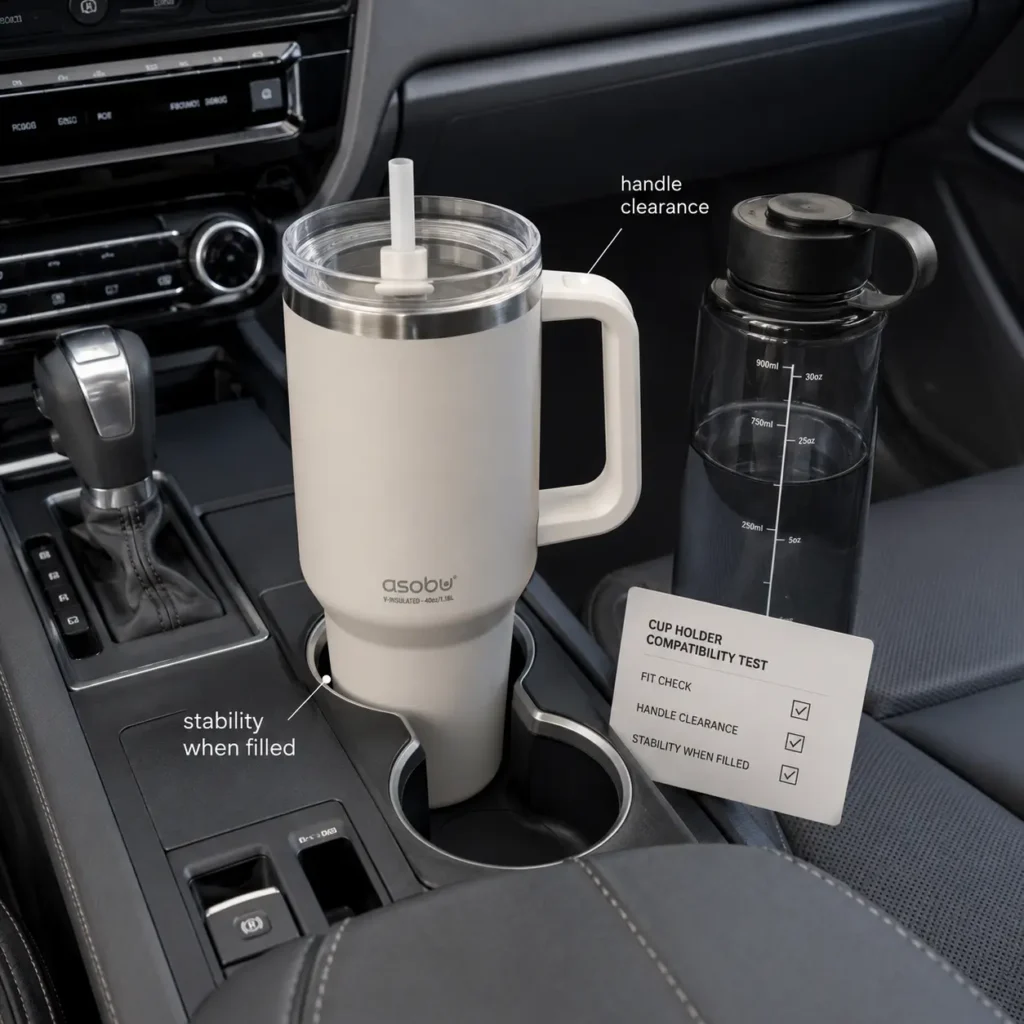
Cup holder fit is not controlled only by one diameter.
Vehicle holders can vary in:
- opening diameter
- internal taper
- depth
- rubber inserts
- console shape
- adjustable grips
This is why manufacturers usually work with practical product geometry rather than promising universal compatibility.
For existing successful tumbler models, the best evidence is often:
- existing market history
- previous buyer feedback
- physical dimension
- real use testing
For a completely new ODM design, buyers should test prototypes in several representative vehicle environments.
If the product is targeted mainly at the US market, vehicle use may deserve particularly strong attention for large lifestyle tumblers and travel mugs.
If the product is mainly an outdoor bottle for European hiking retailers, cup holder fit may be a secondary concern.
Product-market fit should decide the test standard.
Recommended Route for Buyers
Route A — Proven Car-Compatible Existing Model
Best for:
- new brands
- Amazon sellers
- corporate gifts
- low-MOQ launches
- commuter collections
Choose an existing bottle with a proven tapered base and established lid/handle structure.
Then customize:
- logo
- color
- packaging
- straw
- silicone boot
This is the lowest-risk route.
Route B — Existing Bottle + Accessory Customization
Best when the main body already fits the cup holder but the buyer wants stronger differentiation.
Possible changes include:
- Pantone body color
- custom logo
- matching silicone boot
- custom straw color
- gift box
The final finished diameter should still be rechecked.
Route C — New ODM Body Shape
Best for:
- established brands
- high-volume launches
- proprietary designs
- products where car fit is a major selling feature
This may involve:
- custom taper
- custom body width
- new handle position
- custom lid geometry
- new tooling
Prototype testing becomes important because even small geometry changes affect:
- capacity
- stability
- ergonomics
- packaging
- cup holder compatibility
What to Prepare Before Requesting a Quote
For a cup-holder-focused drinkware project, buyers should provide:
- target capacity
- target quantity
- target market
- main sales channel
- target use scenario
- preferred product style
- reference bottle image
- whether a handle is required
- whether a silicone boot is required
- logo design
- packaging requirement
- target launch date
If cup holder compatibility is critical, also tell the manufacturer directly:
The bottle is mainly for commuter/car use and cup holder fit is a key requirement.
This allows the supplier to filter out unsuitable models before sending recommendations.
For example, instead of receiving 20 random 1L bottles, the buyer may receive only three models with:
- tapered base
- suitable handle
- correct capacity
- realistic MOQ
That makes product selection much faster.
Common Mistakes Buyers Should Avoid
Checking Only Maximum Body Diameter
The base diameter is more important for cup holder fit.
Always request both.
Adding a Silicone Boot After Approval Without Retesting
The boot changes the finished outside diameter.
Test the final product configuration.
Assuming All 40oz Tumblers Fit Cars
Capacity alone does not determine compatibility.
Body geometry matters.
Ignoring the Handle
The base may fit while the handle collides with the vehicle console.
Testing Only an Empty Bottle
Filled weight changes stability.
Test the bottle with water.
Choosing Cup Holder Fit Over the Main Product Function
An outdoor hiking bottle does not always need a narrow car base.
Do not compromise the primary use scenario unnecessarily.
Using “Fits All Car Cup Holders” as a Marketing Claim
Vehicle dimensions vary.
Use realistic wording and validate the product before making broad claims.
Developing a New Body Too Early
For first orders, proven existing tapered models usually offer much lower development risk.
Buyer Checklist
Before approving a water bottle for car or commuter use, confirm:
- base diameter
- maximum body diameter
- body taper
- total height
- cup holder insertion depth
- handle width
- handle clearance
- finished diameter with silicone boot
- filled bottle stability
- center of gravity
- straw height
- lid clearance
- leak-proof performance
- packaging dimensions
- bottle capacity
- target market
- real-use scenario
- sample testing
- customization MOQ
- tooling requirements
FAQ
What bottle diameter fits a car cup holder?
There is no single universal diameter because vehicle cup holders vary. Buyers should focus on a narrow practical base design and test the final bottle in representative vehicle environments.
Why do 40oz tumblers fit cup holders even though they are very wide?
Many 40oz tumblers use a tapered body. The upper section provides high capacity while the lower base is much narrower.
Is base diameter more important than bottle diameter?
For cup holder compatibility, yes. The maximum body width may sit above the vehicle console, while the base is the section that enters the holder.
Does a silicone boot affect cup holder fit?
Yes. A silicone boot increases the finished outside diameter and can also increase friction when inserting or removing the bottle.
Are straight bottles bad for car use?
No. A straight bottle can work well if its diameter is sufficiently compact. The issue is the actual base width, not the straight shape itself.
Which bottle shape is best for commuters?
A tapered tumbler or compact travel mug is usually a strong choice because it combines capacity, portability, and vehicle compatibility.
Do large outdoor bottles need to fit cup holders?
Not always. If the bottle is mainly used for hiking, camping, or backpack carrying, handle design, durability, and leak-proof performance may be more important.
Can a custom 1L bottle be designed with a cup-holder-compatible base?
Yes, but a narrow base combined with high capacity affects body shape, stability, tooling, and ergonomics. This normally becomes an ODM development project.
Should cup holder testing be done before mass production?
Yes, if vehicle compatibility is part of the product positioning. The final bottle, including the handle and silicone boot, should be tested before approval.
Can we order a low-MOQ cup-holder-compatible tumbler?
Yes. Using an existing model and stock components allows much lower MOQ than creating a new bottle body.
Conclusion
Water bottle cup holder fit is a small specification that can have a large impact on product usability.
For commuter, lifestyle, coffee, fitness, and large tumbler markets, the most important dimension is usually the base diameter, not the maximum body width.
A tapered body allows manufacturers to combine a larger drinking capacity with a narrower lower section, which is why this structure is common in 30oz and 40oz car tumblers.
However, the base is only part of the decision.
Buyers should also evaluate:
- handle clearance
- silicone boot thickness
- bottle height
- center of gravity
- filled weight
- stability
A bottle that technically fits the holder but rocks heavily or collides with the vehicle console may still create a poor user experience.
For first-order OEM projects, the safest route is usually to start with an existing proven cup-holder-compatible model and customize the bottle through logo, color, packaging, and accessories.
Full ODM development becomes more appropriate when the brand has enough order volume to justify a proprietary base shape, handle position, or structural design.
Most importantly, cup holder compatibility should follow the target market.
A commuter tumbler should be designed around vehicle use.
An outdoor hiking bottle does not need to sacrifice durability or carrying performance simply to fit a car.
Need a bottle or tumbler designed for commuter and car use? Send us your target capacity, quantity, market, handle requirement, and reference design. We can recommend existing cup-holder-compatible models before considering new tooling.
👉 Contact us for OEM stainless steel drinkware customization, logo printing, Pantone color matching, packaging solutions, and fast quotations for your next project.