The practical question behind golden sample vs pre-production sample is what a buyer is authorising before a custom drinkware order moves forward. One term usually describes a sample’s place in development; the other describes its role as an agreed physical reference. A bottle can serve both purposes, but only when the parties identify the exact build, review the relevant evidence and document the approval scope.
For an importer or private-label brand, the risk is straightforward. A beautiful sample may use a temporary cap, a manually adjusted fit or a decoration process that differs from production. Calling it a golden sample does not resolve those differences. Equally, a production-representative sample does not become approved simply because it was sent before the order started.
This guide uses working definitions for purchasing discussions, not a universal certification system. Supplier terminology varies. Ask what each sample represents, how it was made, what remains different from the intended order and which decision it supports. Then connect the physical bottle to a written specification and release record.
Golden sample vs pre-production sample: the useful distinction
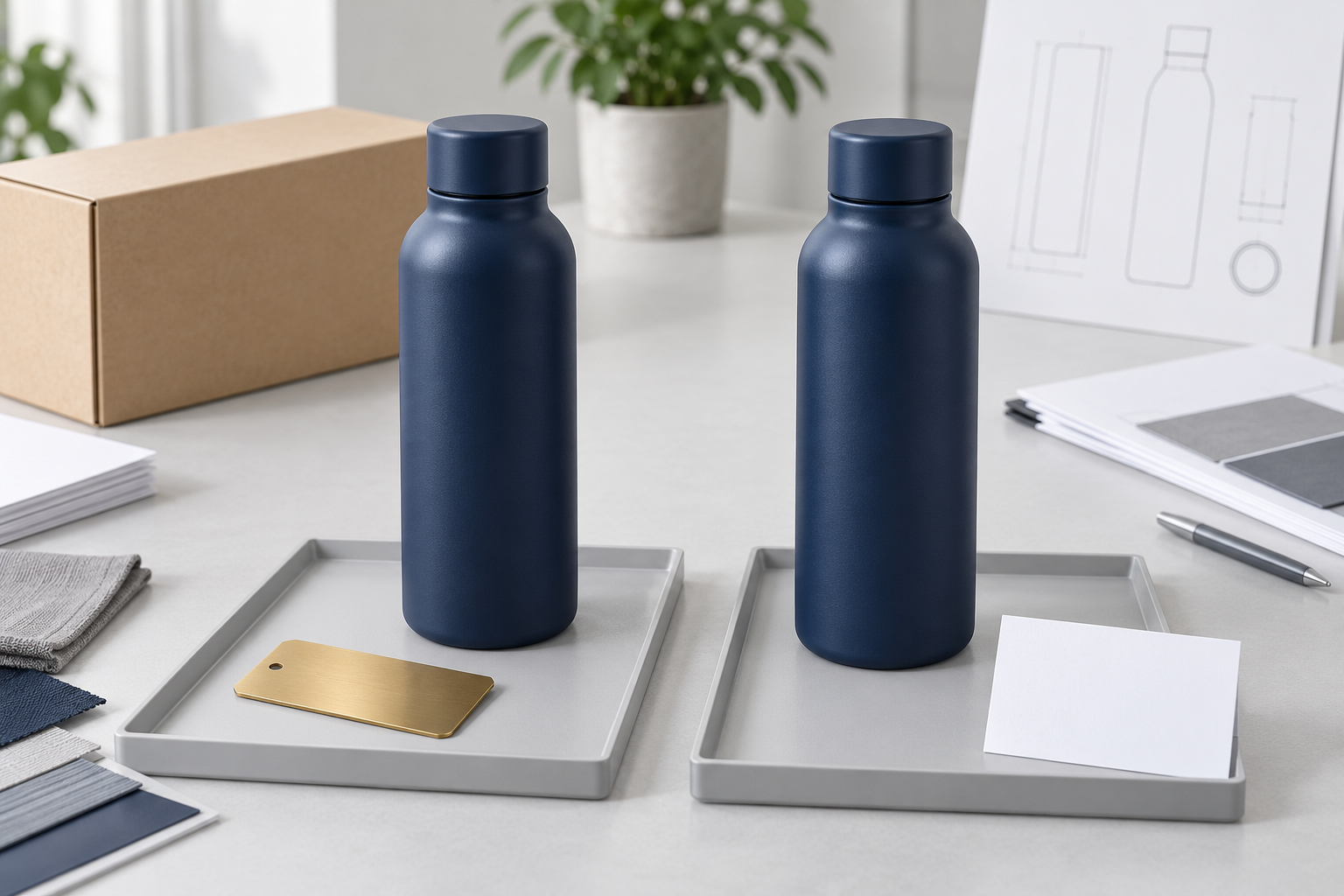
A pre-production sample, as used here, is a sample presented to evaluate the proposed product before bulk production. Its value depends on how closely its materials, components, tooling and processes represent the intended order. The buyer should know which features are representative and which still require confirmation.
A golden sample, as used here, is a specifically identified sample accepted as a physical reference for a stated purpose. That purpose may include appearance, fit or another agreed characteristic. It must be clear which written requirements and approved deviations accompany it. The word golden refers to reference status; it does not mean a gold-coloured bottle or a particular level of certification.
The key difference is therefore between being submitted for a development decision and being accepted as a reference. A pre-production sample may become the golden sample after review. It may instead be rejected, approved for a limited purpose or replaced by a later revision. Neither label should hide an unresolved production difference.
| Buyer question | Pre-production sample | Golden sample |
|---|---|---|
| What does the term describe? | A sample intended to evaluate the proposed product before the bulk run | An identified physical reference accepted for a defined purpose |
| What must be established? | How its build relates to the intended production configuration | Its approval scope, revision and relationship to written requirements |
| Is it automatically approved? | No; it is submitted for a decision | Approval must be supported by an actual record, not only the name |
| Can one unit serve both roles? | Yes, if suitable evidence supports its acceptance | Yes, if that exact unit is identified as the approved reference |
| Does it prove every production unit conforms? | No | No; production checks and applicable testing remain separate |
| What happens after a change? | Review whether a revised sample or evidence is needed | Review whether the reference and its approval remain applicable |
Ask what the sample was actually made from
Confirm the complete product configuration
Record the bottle model, nominal capacity, body construction, lid revision, gasket, handle and accessories. Link the sample to a bill of materials or equivalent component list appropriate to the project. The purpose is to establish the combination being considered, not to request confidential manufacturing information unrelated to approval.
A simple screw-cap bottle and the same body with a straw lid are different configurations. A sample without a silicone boot may not represent the boxed retail set. Even when the body is unchanged, an accessory or closure difference can affect fit, use instructions and the packaging that accompanies the product.
Also identify the finish, colour reference and artwork revision. If the sample includes a placeholder logo or an available stock colour, say so. Separate the properties that can be reviewed now from those that need a later physical sample, proof or other evidence. Avoid describing the whole product as final when only the body selection is settled.
List differences from the intended production route
Ask the supplier to disclose relevant substitutions and special handling. Was the sample made with intended production tooling? Did an operator manually adjust a component? Was the finish applied through the proposed process? An early sample can still be useful, but the buyer needs to understand its limits before relying on it.
There is no reason to reject every sample made through a development route. A machined prototype may answer a design question, while a separately prepared decoration sample answers an artwork question. The mistake is treating those answers as proof that the final combination can be produced consistently without further review.
Create a short differences register. For each difference, state the affected requirement, what evidence will close it and who authorises closure. This gives the buyer a practical choice between proceeding with a limited activity and holding the affected production step. A vague promise that bulk goods will be better is not a documented resolution.
Use a specification alongside the physical reference
A physical sample is particularly helpful for discussing visible appearance and practical interaction, but it cannot communicate every requirement. Material identity, performance criteria, approved care wording and allowable dimensional variation need appropriate documentation and evidence. A reference bottle should guide inspection together with that information.
Identify which document controls each characteristic. Dimensions can point to an approved drawing and agreed tolerances. Decoration can point to released artwork and an appearance reference. Functional evaluations can point to a defined procedure and acceptance criteria. When the sample differs from a requirement, resolve the discrepancy rather than asking an inspector to guess which takes priority.
Do not quietly turn an incidental feature of one sample into an uncontrolled specification. A small mark may be accepted as a sample-only exception, while a colour variation may be the very characteristic the buyer wants to control. Record the distinction. Otherwise, two people can inspect the same bottle and reach different conclusions about what approval meant.
For a colour-sensitive project, our custom bottle colour sample approval guide addresses the physical reference and appearance discussion in more detail. The golden-sample record should link to that agreed reference rather than replacing it with an informal photograph.
Review appearance, fit and function separately
Appearance approval should identify the viewing basis
Inspect the finish, logo position, decoration edges and other customer-visible areas under agreed conditions. A phone image can help point out a problem, but differences in lighting and display make it a limited basis for a sensitive appearance decision. Keep the actual reference and any agreed measurement approach available to the parties reviewing production.
State whether the sample is accepted for colour, finish, logo layout or the complete appearance combination. If artwork is still being revised, an appearance sign-off should name the accepted features and exclude the open ones. This lets the supplier proceed on a sound basis without interpreting a partial decision as approval of every visible detail.
Fit checks should use the intended mating parts
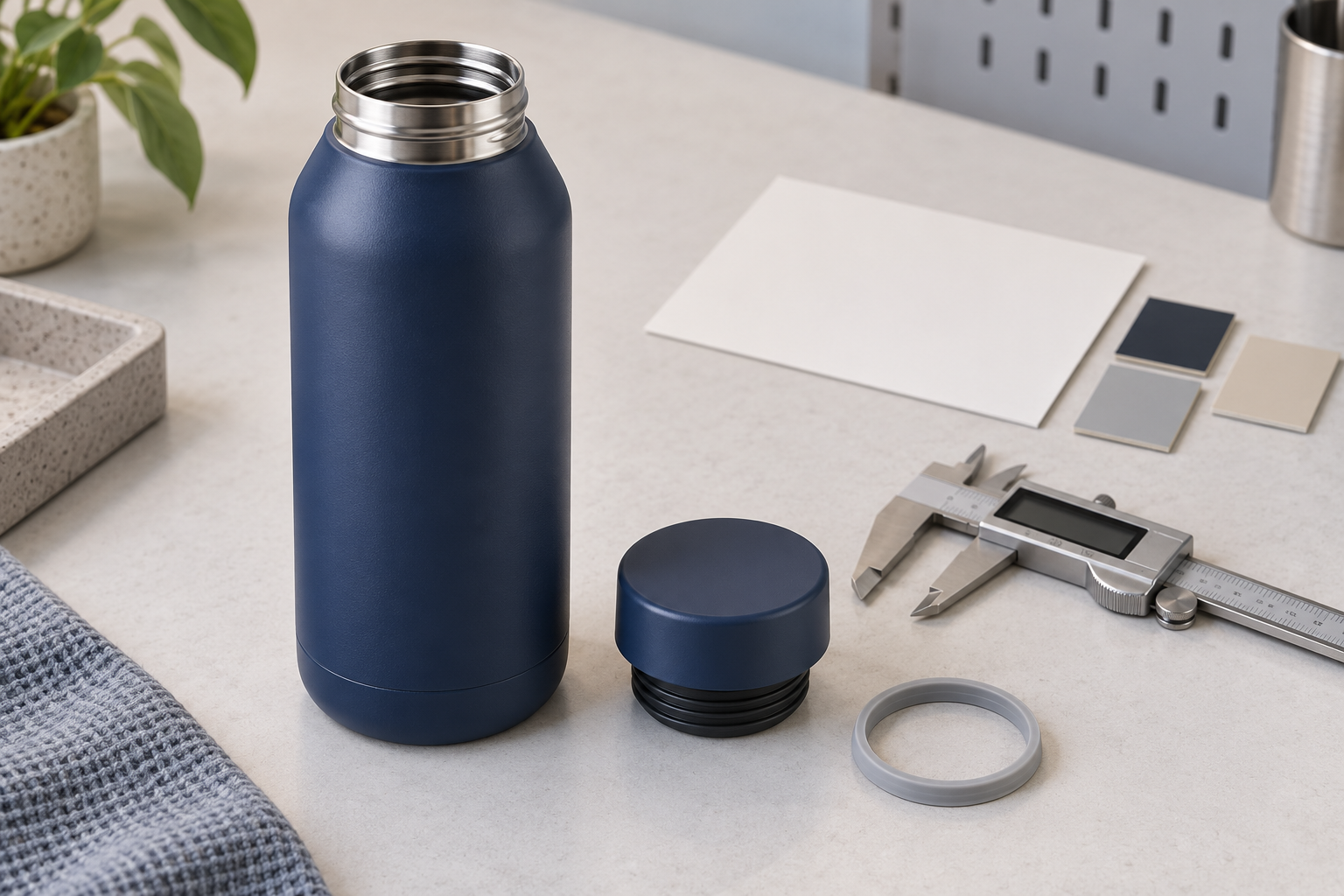
Review the cap and bottle together, with the specified gasket and any removable pieces installed correctly. Observe closure operation, seating and access for ordinary cleaning or reassembly where those matters are part of the brief. A convincing fit between two hand-selected sample parts should lead to questions about production variation, not an assumption that every manufactured combination will behave identically.
The supplier should propose the relevant dimensional and assembly controls for the selected design. Avoid inventing a universal torque, clearance or tolerance for all drinkware. If a critical interface remains uncertain, ask what measurements or further sampling will establish an acceptable production requirement before the configuration is released.
Our bottle lid sample testing guide focuses on closure-specific review. Here, the important approval question is which lid version and evidence belong to the retained reference, especially if the buyer is evaluating more than one cap option.
Performance conclusions need their own evidence
Agree how the required function will be evaluated and what result is acceptable. A visual comparison cannot establish insulation performance, and an attractive logo does not establish decoration durability. Keep the tested configuration, procedure and results associated with the relevant revision so that the conclusion can be interpreted correctly.
Some checks can alter or destroy a sample. Plan separate units when needed, and distinguish the retained physical reference from specimens used in evaluation. Do not keep a damaged test specimen as the only appearance reference and expect future reviewers to reconstruct how it looked before testing.
Decide what the approval releases
Approval and production authorisation should be connected explicitly. The buyer may accept a colour reference while holding the final artwork, or approve a component for a named purpose while waiting for the complete product evaluation. Record which activity can proceed and which remains on hold.
A useful approval message identifies the sample code, specification revision, accepted characteristics, open issues and the next authorised activity. Depending on the project, that activity may be preparing revised samples, arranging an agreed early run or proceeding with the defined production configuration. It should not be inferred from an enthusiastic comment about appearance.
Separate technical sign-off from commercial commitments. A product manager may approve fit while purchasing still needs to confirm cost or delivery implications. Likewise, a commercial agreement should not be treated as evidence that the technical review has finished. Name the people responsible for each decision and give the supplier one consolidated release record.
QIMA’s sample review and picking service describes reviewing samples against technical files, specifications and other agreed criteria at different stages. This supports treating sample review as a comparison with defined requirements. It does not establish a universal meaning for a supplier’s golden-sample label.
Build a concise approval record
The following purchasing checklist can be adapted to your own quality system. It is a proposed record structure, not a prescribed certification form. Keep the entries specific enough that the factory, buyer and inspector can connect the decision to the same physical and documentary evidence.
| Record field | What to identify | What the buyer should resolve |
|---|---|---|
| Project and sample identity | Order or project reference, sample code, revision and date | Whether everyone is reviewing the same unit and version |
| Product build | Body, lid, seal, finish, artwork and included accessories | Any mismatch with the proposed sellable configuration |
| Production representativeness | Known tooling, material or process differences | Which differences need further evidence before release |
| Written requirements | Applicable specification, drawings and evaluation records | Which reference controls each approved characteristic |
| Decision and scope | Accepted features, rejected features and approved exceptions | Whether approval is complete or limited to a named purpose |
| Release authority | Named reviewer, decision date and authorised next activity | Who can close outstanding issues or approve changes |
| Reference custody | Who holds each identified reference copy | Whether buyer, factory and inspection team have access |
| Change history | Superseded versions and reasons for revision | When the reference must be reviewed again |
Photograph the sample and identifying record together, while keeping the physical unit available for relevant comparisons. The photograph helps locate the right item; it does not replace the item for every decision. If tags can become detached, use an agreed identification method that does not damage the surfaces being reviewed.
Keep comments specific. Instead of writing that the bottle is almost right, state which feature is accepted, which is not, and the evidence required for the next decision. This reduces the chance that a supplier interprets a request for improvement as permission to produce the current version.
Connect the product reference to packaging approval
Identify the retail configuration that accompanies the approved bottle. A different lid or handle can affect carton fit, and an added accessory changes what must be packed. The physical product reference and the packaging approval record should point to the same component list, even when they are maintained as separate documents.
Do not use the packaging reference to hide an incomplete product decision. A box can be approved for artwork while the insert remains provisional. Equally, a structurally correct pack does not approve care claims printed on it. State the remaining dependencies before bulk printing or packing begins.
The previously completed packaging sample approval checklist covers carton structure, inserts and print release. This article addresses the separate role of the product sample: which bottle configuration becomes the agreed reference, and what production evidence is still required.
Choose reference copies and evaluation samples deliberately
Agree how many samples are needed for the decisions being made. The retained appearance reference, functional specimens, buyer review copy and factory working reference may serve different purposes. Do not state a fixed sample quantity without considering the product, the evaluations and the people who need access.
If the buyer and factory retain separate units, review them against the same requirements before treating them as equivalent references. Give each unit an identifier linked to the same approved revision, and record any unit-specific differences. Two bottles made in one sampling round should not automatically be considered indistinguishable.
Explain how the inspection provider will access the appropriate reference and written criteria. Avoid sending an inspector only a purchasing email that mentions a golden sample held somewhere else. Plan enough time for the reference to reach the required location and for questions about the approval scope to be resolved before inspection.
Protect the retained sample from routine use or uncontrolled alteration. A lid that has been swapped during a sales demonstration may no longer represent the approved build. If a working copy is needed for demonstrations or repeated assembly checks, distinguish it from the reference whose condition matters to future comparisons.
Check the start of production against the approved basis
Sample acceptance is one milestone, not a measurement of an entire order. Agree which early production checks are appropriate for the project. The purpose is to establish whether the intended materials, parts and processes are being used and whether the emerging output agrees with the accepted specification and physical reference.
QIMA describes its initial production check as an inspection that can take place from pre-production through early production. Buyers can discuss the scope and timing of a suitable check with their provider. This is a separate activity from accepting a couriered sample; the two should not be presented as interchangeable evidence.
For an established model with limited decoration changes, the evidence plan may differ from a newly developed closure. Ask the supplier which risks remain after sample approval and how they will be monitored. Do not copy a development plan from a different product without reviewing whether it answers the current project’s questions.
Keep the release decision and inspection plan compatible. If the supplier is authorised to prepare a limited quantity for review, identify that scope rather than leaving the quantity open. If the buyer has authorised the agreed production configuration, document how changes and nonconforming results will be communicated during the run.

Control revisions without erasing earlier decisions
When a new sample arrives, identify what changed and why. Link it to a change request, updated specification or corrected artwork. Ask the supplier to explain whether the revision affects other characteristics, such as the relationship between lid dimensions, sealing behaviour and packaging clearance.
Mark older samples and files as superseded while preserving their history. Do not leave several unlabelled bottles on the same shelf and rely on memory to select the current reference. A revision register should make it possible to see which sample controls the next order and which was used for a previous decision.
Set change-notification expectations for production and repeat orders. A substitute component, different material source or revised decoration process may require a fresh assessment of the existing approval. The response should match the affected requirements; it need not be an automatic restart of every development activity.
Keep rejected features out of the released reference unless the exception is documented clearly. A buyer may accept a sample for colour while rejecting its logo position. That bottle can still serve a limited purpose, but it must not become an unqualified golden sample for the complete appearance simply because it is the latest unit received.
A hypothetical OEM bottle approval
Consider a hypothetical fitness brand ordering a matte bottle with a simple screw cap, laser decoration and a paperboard retail carton. The supplier submits a pre-production sample using the intended bottle and finish, but the cap colour is an available stock alternative and the artwork remains a trial revision.
The brand likes the bottle shape and finish. It records approval of those specific features, while holding the cap colour and logo position. The sample is useful development evidence, but a general instruction to copy it would reproduce two features that the buyer has not accepted.
The supplier then supplies a revised complete configuration. The buyer reviews the identified cap, released artwork and relevant evaluation evidence, checks the packaging connection and records the approval scope. Suitable retained units become the physical references associated with that revision.
Before the next production step, purchasing confirms the authorised activity and the supplier acknowledges the same references. Early production review compares the emerging output with the agreed requirements. If the closure changes later, the team assesses the affected evidence instead of assuming that the earlier golden sample covers every future version.
This example describes a purchasing sequence, not an actual ShinyStar customer case or a guarantee of a particular production outcome. Its lesson is that approval becomes useful when the decision, sample and intended manufacturing configuration are connected explicitly.
Questions to send with a sample request
Give the supplier enough context to prepare relevant evidence. State the selected model, target use, intended decoration and accessory combination. If your team uses specific sample names, define them in the request instead of assuming the supplier follows the same vocabulary.
- Which materials, components and processes will this sample represent?
- What will differ from the intended production build?
- Which specifications and artwork revisions will accompany it?
- Which features should the buyer review on this unit?
- Which evaluations need separate specimens or reports?
- How will approved features and unresolved differences be recorded?
- Which units will become retained references, and who will hold them?
- What activity will the approval authorise next?
- How will later substitutions or revisions be notified?
Ask for project-specific sample cost and timing rather than relying on a generic promise. A stock body with a new logo, a new closure and a multi-component retail set can require different preparation and review work. The quotation should make the included sample scope understandable.
Frequently asked questions
Is a golden sample always the same as a pre-production sample?
Not necessarily. In this guide, pre-production describes the proposed sample stage, while golden describes an accepted reference role. One unit can serve both, but the buyer needs an actual approval record and a clear understanding of production differences. Confirm how your supplier uses the terms before relying on the name.
Can an early prototype become the final reference?
It may remain useful for a limited characteristic, such as shape or appearance, if that scope is documented. It should not be treated as proof of a production feature it does not represent. Identify what the prototype can demonstrate and request the additional evidence needed for the intended configuration.
Does approval of one bottle approve every colour or lid?
No automatic extension should be assumed. Map the approved configuration to the proposed variants and identify differences that affect the requirements. The supplier and relevant reviewer should explain which evidence can be shared and which variants need further review. Keep that rationale with the product approval.
Can photographs replace sending the physical sample?
They can support identification, layout discussion and some visible corrections, but they do not answer every fit, appearance or functional question. Decide which review can be completed remotely and what remains unverified. If an important release depends on a physical characteristic, arrange suitable access or evidence before authorising the affected activity.
What happens if the written specification disagrees with the sample?
Resolve the conflict before release. Identify the affected requirement, decide whether the specification or sample needs revision, and record who approved the resolution. Do not leave the factory or inspector to decide silently which source takes priority. A physical reference works best when it agrees with the written approval basis.
Does a golden sample replace food-contact or performance testing?
No. A retained reference does not establish every material, regulatory or performance property. Use applicable product-specific evidence for those requirements and link it to the relevant configuration. Do not interpret a visible approval tag as a certificate or as proof that the sample has undergone every evaluation the market requires.
Should the buyer sign a sample that still needs changes?
Record a limited decision only if its scope is explicit. Identify the accepted features, rejected features, open actions and production activity that remains on hold. If the decision would be ambiguous, request a corrected sample or record before proceeding. A signature without scope can create more confusion than clarity.
What should ShinyStar receive before arranging the next sample?
Provide the selected model, lid, finish, artwork, accessory list and the questions your team needs the sample to answer. Include the target order and any required review evidence. ShinyStar can discuss a suitable sampling scope for that configuration; cost, timing and any additional evaluation must be confirmed for the project.
Approve a defined configuration, then keep it traceable
The useful distinction in golden sample vs pre-production sample is a practical one: what the unit represents and what the buyer has accepted. Record the intended build, disclose differences, review relevant evidence and define the authorised next step. A name alone cannot provide those answers.
Once approved, keep the physical reference, specification and revision record accessible to the people who will use them. Compare production against that agreed basis and review changes before extending old approvals to a new configuration.
For a custom drinkware project, send your product brief and sample requirements through the ShinyStar quote and sample enquiry page. A clear request helps establish what the next sample should demonstrate before either team commits to bulk production.